

Power Info
Introduction
Power Info is an array power monitoring system designed by aBMC for array servers. The system consists of three parts: power supply overview, output power trend and power module details. Users can centrally view the power module's in-place status, health status, rated power, input and output electrical parameters, and power change trends, and promptly identify problems such as power loss, abnormal operation, or insufficient power supply capacity.
Development Vision
- Provide users with visual power status and output power trends to facilitate customers to continuously understand the power supply status and power changes of array servers.
- By uniformly displaying the presence, health, and electrical parameters of the power module, it improves the efficiency of power failure judgment and reduces the impact of a single power module abnormality on the stable operation of the array.
Feature Usage
View power information
Open the power information page
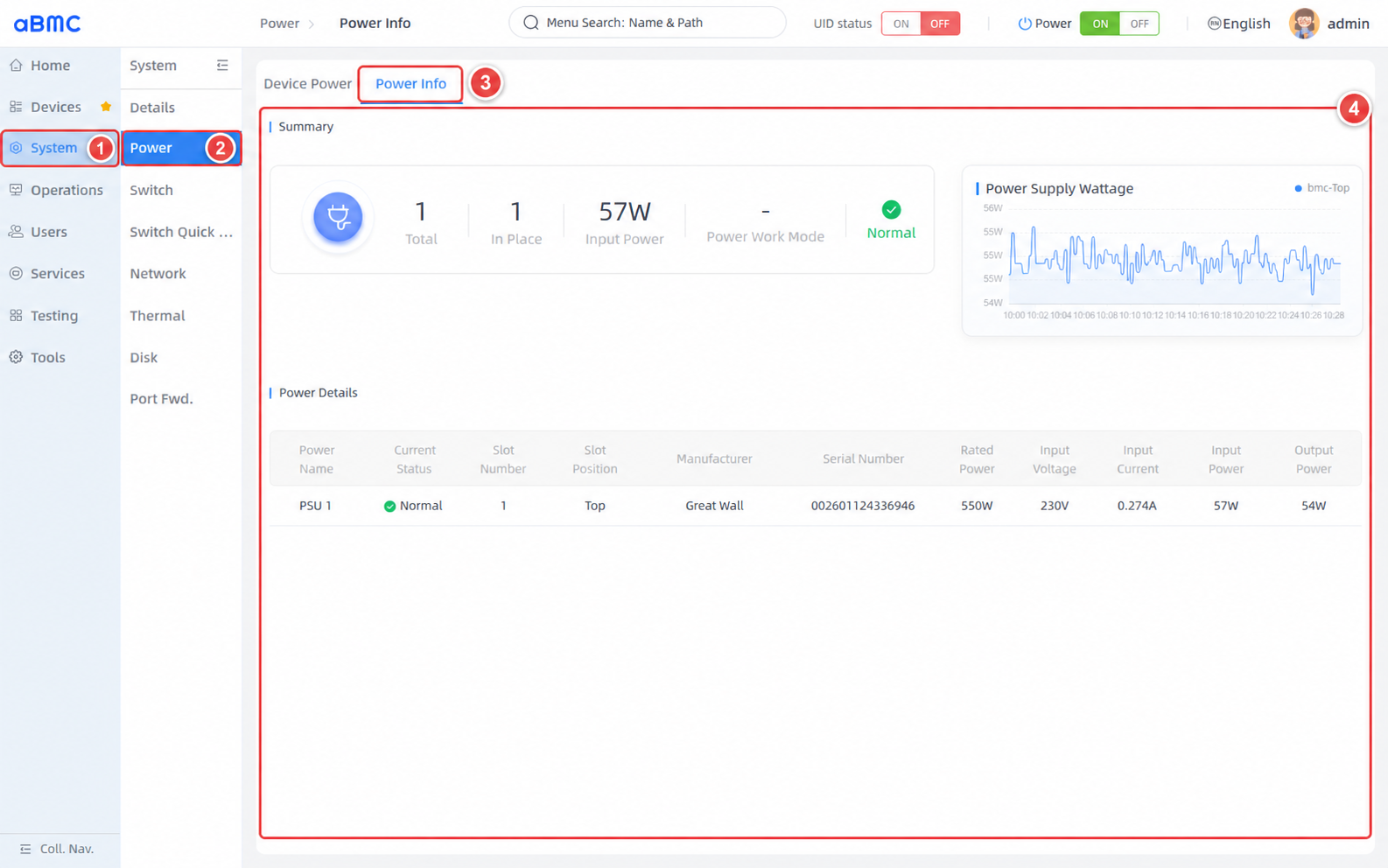
- Select System in the main navigation on the left.
- Select Power in the secondary navigation bar.
- Click Power Info at the top of the page.
- Wait for Summary, Power Supply Wattage and Power Details to finish loading.
View power supply overview
- Check the total number and number of power modules in Summary.
- Check the current Input Power and Power Work Mode.
- Check the overall health status on the right side of the overview. When the status is Abnormal, you should continue to check for abnormal power modules in Power Details.
Power overview field description
| Field | Description | Checkpoints |
|---|---|---|
| Total | The total number of power modules recognized by the system. | should be consistent with the number of power modules planned to be installed on the equipment. |
| In Place | The number of power modules currently in place. | When it is less than Total, check the slot, installation status and power supply connection of the missing power module. |
| Input Power | The total value of the current power module input power; when the input power cannot be obtained, the page may use the consumed power returned by the system. | Judgment should be based on equipment load and historical trends, and abnormalities should not be confirmed based on only one sampling. |
| Power Work Mode | Current power work mode, may include Load Balancing, Sharing or Active Standby. | When the device does not return to the working mode, - is displayed, which does not mean that the power module must be abnormal. |
| Health Status | An overall judgment generated based on the status of the in-place power module and the power health status returned by the system. | When Abnormal is displayed, check the details, device alarms, and system logs one by one. |
View output power trend
- View the output power curve of each power module in Power Supply Wattage.
- Use the location name in the legend to identify the corresponding power module. For example, bmc-Top indicates the power module in the top slot of the BMC.
- Observe whether the power continues to fluctuate violently, suddenly drops to
0, or there is a lack of data for a long time. - The page automatically refreshes power supply details and output power trends every
15seconds, without manual refresh.
Power Trend Description
The trend graph shows the historical sampling value of the power module output power. There may be slight differences between the end value of the trend chart and the current Output Power in Power Details due to different sampling times, and should be judged based on the continuous trend and current details.
View power module details
- Confirm the target power module based on the Power Name and slot information in Power Details.
- Check whether Current Status is Normal.
- Check whether the rated power, input voltage, input current, input power and output power comply with the device specifications and current load conditions.
- When the Not In Place or Abnormal status is found, record the slot, manufacturer, and serial number, and combine device alarms and on-site connections for further investigation.
Power supply details field description
| Field | Description | Checkpoints |
|---|---|---|
| Power Name | Power module name, for example PSU 1. | Confirm the target power module before operation and troubleshooting. |
| Current Status | Current status, including Normal, Not In Place, and Abnormal. | Check module installation, power supply connection and device alarms when in non-Normal state. |
| Slot Number | The slot number where the power module is located. | Used to locate the physical slot in the device. |
| Slot Position | The position of the power module, such as Top. | should be consistent with the actual installation location of the device. |
| Manufacturer | Power module manufacturer. | Used to check compatibility and device specifications when replacing modules. |
| Serial Number | Power module serial number. | Used for asset recording, fault tracking and after-sales positioning. |
| Rated Power | Rated power of the power module, in W. | The power supply design requirements of the equipment should be met; it cannot be judged whether the rated capacity is exceeded based only on the current input power. |
| Input Voltage | The current input voltage of the power module, in V. | Should be within the allowable range of the power module and on-site power supply system. |
| Input Current | The current input current of the power module, in A. | A comprehensive judgment should be made based on the input voltage, input power and equipment load. |
| Input Power | The current input side power of the power module, in W. | Should be observed based on historical trends to see if there are any abnormal mutations. |
| Output Power | The current output side power of the power module, in W. | Typically lower than the input power; the difference is related to power conversion losses and measurement error. |
Confirm power status
- Confirm that Total is consistent with the planned installation quantity of the equipment, and In Place is equal to the actual in-place quantity.
- Confirm that the overall health status and the Current Status of each power module are Normal.
- Continuously observe Power Supply Wattage to confirm that the output power can be updated normally and there are no continuous mutations without business reasons.
- Compare the rated power, input and output parameters, and current equipment load; when abnormalities are found, further check equipment alarms, system logs, power lines, and on-site power supply environment.
Status refresh instructions
The page re-fetches power module details and output power trends every 15 seconds. When the power module has just been inserted or unplugged or the power supply status has just changed, please wait for the next refresh and confirm again.
FAQ
The power supply operating mode or electrical parameters are displayed as -
The device may not provide the corresponding field, or the status reading may temporarily fail. First confirm that the power module status and BMC communication are normal, wait for the page to automatically refresh and then check again; if other key fields are missing at the same time, you should combine device alarms and interface responses to troubleshoot.
The power module displays as Not In Place or Abnormal
Locate the module according to Slot Number and Slot Position, check whether the module is installed in place, whether the power cord is connected, whether the on-site power supply is normal, and check device alarms and system logs. Before re-plugging or replacing the power module, follow the equipment maintenance practices.
Input power and output power are inconsistent
Power modules generate losses during the conversion process, so Input Power is usually higher than Output Power. There may also be a small difference between the two due to sampling time and measurement accuracy; if the difference continues to increase abnormally, further investigation should be carried out based on load, temperature, equipment alarms and power supply specifications.
There is no data on the output power trend.
Confirm that the power module is in place and in a normal state, and wait for at least one automatic refresh cycle. If there is output power in the details but there is still no data in the trend graph, you should check whether the power monitoring service, historical data collection status, and related interfaces can return data normally.