



Hermes Agent (Cloud Compute)
Hermes Agent is an open-source AI agent framework that supports multiple LLM providers. It offers capabilities such as tool calling, scheduled tasks, MCP protocol support, and web access, and can be used from a terminal CLI or integrated into messaging platforms such as Telegram and Discord.
Platform Support
| Platform & OS | Supported |
|---|---|
| K1 Buildroot | ❌ No |
| K1 OpenHarmony | ❌ No |
| K1 Bianbu LXQT/GNOME | ✅ Yes |
| K3 Buildroot | ❌ No |
| K3 OpenHarmony | ❌ No |
| K3 Bianbu LXQT/GNOME | ✅ Yes |
Installation
Option 1: apt Installation (Recommended)
Install it directly through apt on Bianbu OS:
sudo apt update
sudo apt install hermes-agent
After installation, you can run the hermes command directly without any additional environment configuration.
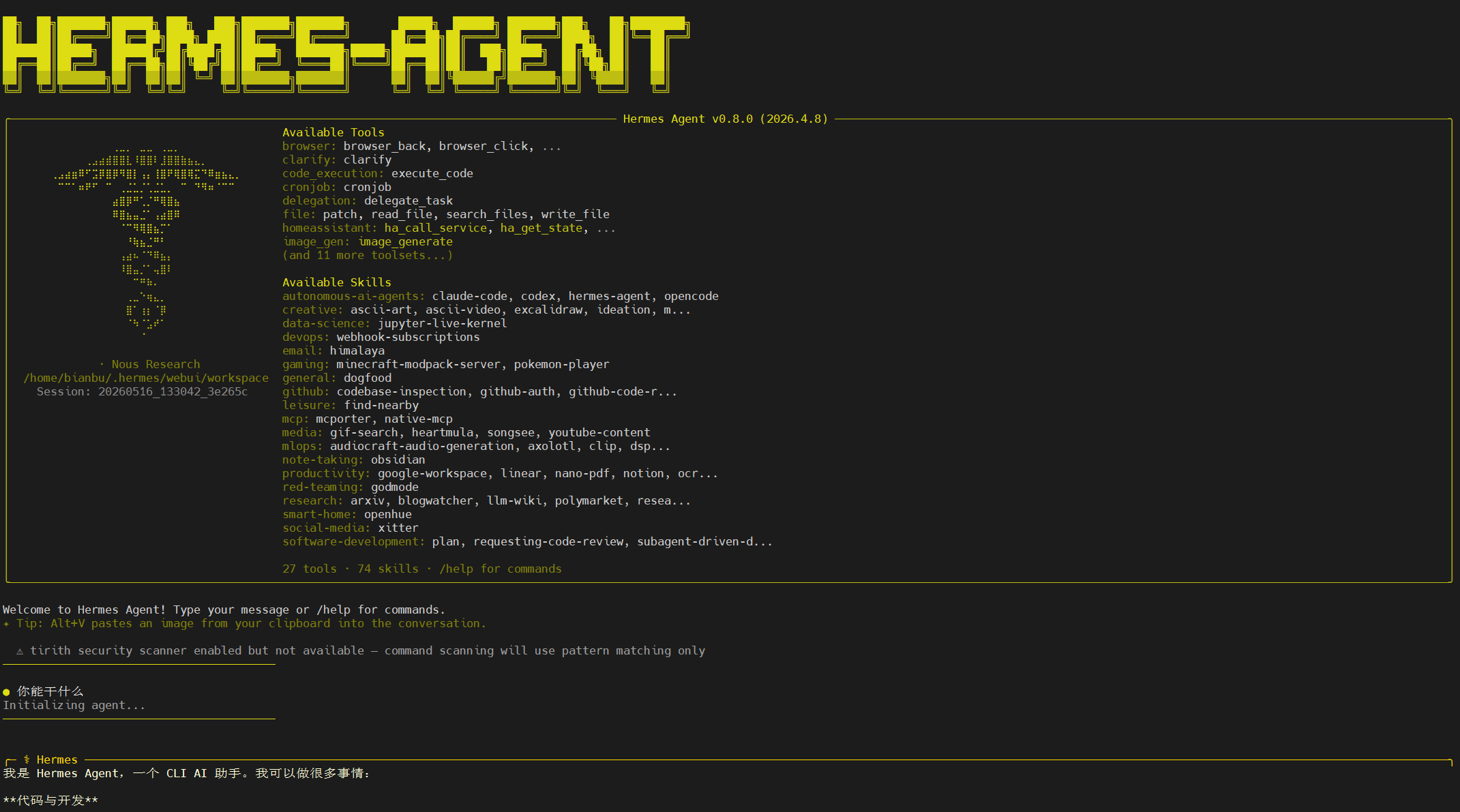
Option 2: Source Installation (For Developers)
This method is intended for users who need to modify the codebase or contribute to development.
Prerequisites
- Python 3.11+ (uv will download it automatically)
libffi8(runtime library, included in the system)libffi-devheaders (must be extracted manually, see below)
Clone the Repository
git clone https://github.com/NousResearch/hermes-agent.git
cd hermes-agent
Install uv
curl -LsSf https://astral.sh/uv/install.sh | sh
source ~/.bashrc
Extract libffi-dev Headers
Building cffi and cryptography on riscv64 requires ffi.h, but the system includes only the runtime library and not the header files. Use apt-get download to fetch the .deb package without installing it or requiring sudo, then extract the headers with dpkg-deb -x:
apt-get download libffi-dev
mkdir -p /tmp/libffi-dev
dpkg-deb -x libffi-dev_*.deb /tmp/libffi-dev
/tmp/libffi-devis removed after a reboot. If you need to reinstall dependencies, run this step again. Existing virtual environments are not affected.
Create a Virtual Environment and Install Dependencies
cd hermes-agent

export PKG_CONFIG_PATH="/tmp/libffi-dev/usr/lib/riscv64-linux-gnu/pkgconfig:$PKG_CONFIG_PATH"
export C_INCLUDE_PATH="/tmp/libffi-dev/usr/include/riscv64-linux-gnu:$C_INCLUDE_PATH"
export CPATH="/tmp/libffi-dev/usr/include/riscv64-linux-gnu:$CPATH"
export LIBRARY_PATH="/tmp/libffi-dev/usr/lib/riscv64-linux-gnu:$LIBRARY_PATH"

uv venv venv --python 3.11
source venv/bin/activate

uv pip install -e ".[cron,cli,dev,mcp,web]"
The
voiceandmessagingextras have limitations onriscv64. See Unavailable Features for details.
Configuration
Configure the API Key
Edit ~/.hermes/.env (generated automatically on first run, or create it manually). The following example uses the MiniMax China endpoint.
MINIMAX_CN_API_KEY=your_key_here
MINIMAX_CN_BASE_URL=https://api.minimaxi.com/v1
For a source installation, you can also edit the .env file directly under the project directory:
cp .env.example .envConfigure the Model
Edit ~/.hermes/config.yaml (generated automatically on first run, or create it manually):
model:
  default: MiniMax-M2.7-highspeed
  provider: custom
  base_url: https://api.minimaxi.com/v1
  api_mode: chat_completions

custom_providers:
- name: minimax-cn
  base_url: https://api.minimaxi.com/v1
  api_key: your_key_here
  api_mode: chat_completions
  model: MiniMax-M2.7-highspeed
The MiniMax API accepts only the plain model name, for example
MiniMax-M2.7-highspeed. Provider-prefixed formats such asminimax-cn/MiniMax-M2.7-highspeedare not supported.
Start the Agent
For an apt installation, run:
hermesFor a source installation, activate the virtual environment each time you open a new terminal:
cd hermes-agent
source venv/bin/activate
./hermes
Supported LLM Providers
Set the corresponding key in .env to switch providers.
| Provider | Environment Variable |
|---|---|
| OpenRouter | OPENROUTER_API_KEY |
| Google Gemini | GOOGLE_API_KEY |
| Kimi / Moonshot | KIMI_API_KEY |
| MiniMax (Global) | MINIMAX_API_KEY |
| MiniMax (China) | MINIMAX_CN_API_KEY |
| GLM / z.ai | GLM_API_KEY |
| Hugging Face | HF_TOKEN |
Unavailable Features
The following features are currently unavailable because of riscv64 platform limitations:
| Feature | Reason |
|---|---|
voice (speech recognition) | ctranslate2 has no riscv64 wheel; faster-whisper depends on it |
| Local STT (speech-to-text) | Same as above |
messaging Discord encryption | pynacl depends on cffi and is skipped because libffi headers are unavailable |
Messaging Feature (Optional)
The messaging feature allows Hermes Agent to connect to messaging platforms such as Telegram, Discord, Slack, WhatsApp, Signal, and Matrix. After configuring the bot token for the target platform, you can interact with the agent directly from those applications.
To enable it in a source installation, first set the libffi environment variables, and then install it separately:
export PKG_CONFIG_PATH="/tmp/libffi-dev/usr/lib/riscv64-linux-gnu/pkgconfig:$PKG_CONFIG_PATH"
export LIBRARY_PATH="/tmp/libffi-dev/usr/lib/riscv64-linux-gnu:$LIBRARY_PATH"
export CPATH="/tmp/libffi-dev/usr/include/riscv64-linux-gnu:$CPATH"
source venv/bin/activate
uv pip install -e ".[messaging]"
Start the messaging gateway:
./hermes gateway