
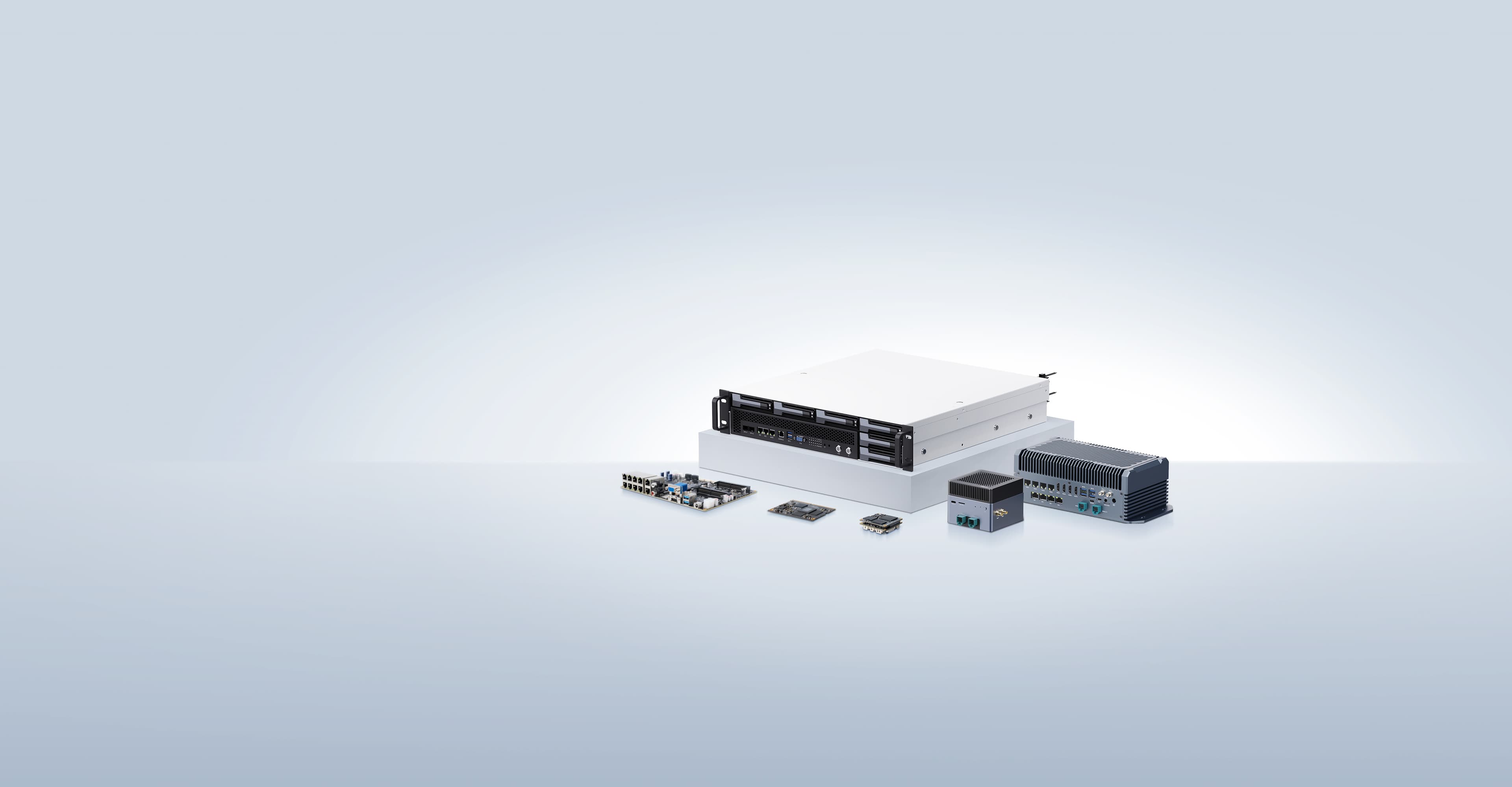


AI NAS
NAS (Network Attached Storage) is a dedicated storage device that provides file, object, backup, media, and application services over network protocols. AI NAS (AI Network Attached Storage) extends traditional NAS storage capabilities with local AI inference. Unlike traditional NAS devices that only provide file storage and sharing, AI NAS can perform image recognition, video analysis, intelligent search, multimodal Q&A, and other AI tasks locally, keeping data off the cloud while improving privacy and latency.
Core Capabilities
- Image intelligence: automatic image classification and tagging, face recognition and album clustering, image-based search, and EXIF metadata extraction.
- Video intelligence: video content analysis and scene splitting, intelligent editing and summarization, real-time video object detection and alerts.
- Document intelligence: OCR, PDF/Office document parsing, semantic vectorization, and full-text search.
- Local Q&A: large language model deployment (RAG), knowledge base management, multi-turn dialogue, and context memory.
- Model management: local model download, version switching, quantized format support, and CPU inference backend configuration.
Platform Support
| Platform & OS | Support |
|---|---|
| K1 Buildroot | ✅ Yes |
| K1 OpenHarmony | ❌ No |
| K1 Bianbu LXQt/GNOME | ✅ Yes |
| K3 Buildroot | ✅ Yes |
| K3 OpenHarmony | ❌ No |
| K3 Bianbu LXQt/GNOME | ✅ Yes |
Technical Architecture
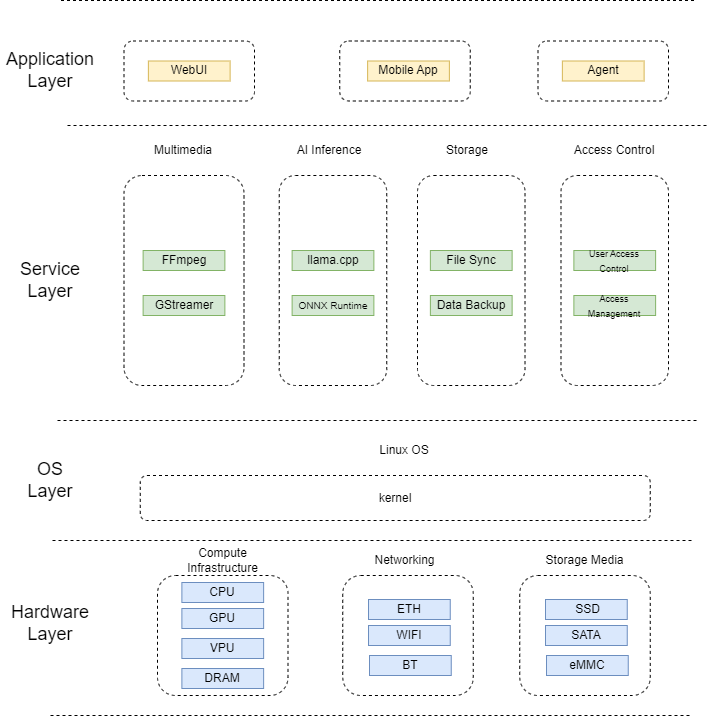
System Architecture Diagram
Development Environment
| Development environment | Use case | Key advantages |
|---|---|---|
| Buildroot | Embedded firmware, minimized system images, lightweight products | Small image size, fast boot, high controllability |
| Debian | Feature validation, application ecosystem, higher-end products | Complete APT/OMV/Docker ecosystem and convenient development |
Buildroot Development Environment
The Linux SDK built with Buildroot supports SpacemiT K-series chips. It includes the supervisor interface (OpenSBI), bootloader (U-Boot/UEFI), Linux kernel, root filesystem (including middleware and libraries), and examples. Its goal is to provide Linux support for the processor and enable driver or application development.
K1 Buildroot
K1 Buildroot development documentation
K3 Buildroot
K3 Buildroot development documentation
Debian Development Environment
The Debian development environment is based on Bianbu OS, SpacemiT's official Debian-derived distribution. Bianbu is an operating system deeply optimized for RISC-V processors. It is built from Ubuntu community source code and provides the system foundation for SpacemiT AI CPUs. Bianbu provides the following images for developers and users:
- GNOME desktop edition: a native desktop edition preinstalled with GNOME Shell, Chromium, LibreOffice, MPV, and other applications.
- LXQt desktop edition: a lightweight desktop redesigned and developed based on LXQt for scenarios with strict resource and performance requirements.
- Minimal edition: a minimal system image that provides a command-line interface.
The Debian NAS solution is developed based on the Bianbu Minimal edition. K1 Bianbu 2.0 is built from Ubuntu 24.04 community sources, and K3 Bianbu 4.0 is built from Ubuntu 26.04 community sources.
The Bianbu development environment and the Buildroot development environment share the same BSP source code.
K1 Bianbu Image
K3 Bianbu Image
Custom Rootfs Image
Multimedia Feature Development
The VPU on the SpacemiT platform is implemented based on the V4L2 framework and provides hardware video encoding and decoding.
- Decode formats: H.264 / HEVC / VP8 / VP9 / MJPEG / MPEG-4
- Encode formats: H.264 / HEVC / VP8 / VP9 / MJPEG
FFmpeg User Guide
GStreamer User Guide
AI Feature Development
AI Development Environment
Buildroot AI Development Environment
The Buildroot release has integrated llama.cpp and spacemit-onnxruntime.
Bianbu AI Development Environment
Install llama.cpp:
sudo apt update
sudo apt install llama.cpp-tools-spacemit
Install spacemit-onnxruntime:
sudo apt-get update
sudo apt-get install -y spacemit-onnxruntime libopencv-dev python3-spacemit-ort python3-pillow python3-matplotlib python3-opencv
AI Features
AI NAS can use SpacemiT's intelligent computing platform AI SDK to implement the following AI features.
Intelligent Media Library
- Image recognition: classification, object detection, face detection, face features, emotion recognition, and pose recognition.
- Video analysis: frame extraction, object detection, multi-object tracking, and key-frame summarization.
- Album features: person clustering, scene tags, duplicate image detection, and natural language search.
- Media Q&A: VLM generates image descriptions and supports queries such as "What is in this image?" and "Find photos with cats."
Private Knowledge Base and RAG
- Document ingestion: PDF, TXT, Markdown, Office documents, and OCR text extracted from images.
- Vectorization: generate knowledge bases by shared directory, user, project, or tag.
- Retrieval-augmented Q&A: the LLM SDK
/api/chatAPI supportskb_idsfor RAG Q&A against specified knowledge bases. - Knowledge base management: the LLM SDK provides APIs for knowledge base creation, file upload, vectorization, progress queries, chunk debugging, and deletion.
- Asset service: the LLM SDK Assets API can proxy MinIO static files and supports Range requests, making it suitable for document, audio, and image previews.
Voice and Meeting Center
- ASR: transcribe audio files for meeting recordings, personal voice notes, and video subtitle generation.
- TTS: convert text to speech for voice announcements and headless device interaction.
- VAD: voice activity detection to reduce silent segment processing.
- Voiceprint / speaker diarization: identify speakers in multi-speaker meeting records and family member scenarios.
Local AI Assistant
- Local chat: the LLM SDK, llama-server, or Ollama provides OpenAI-compatible or REST APIs.
- Model management: download, cancel download, start, stop, switch the current model, and query service status.
- Session management: create sessions, manage message history, rename sessions, and delete sessions.
- Multimodal Q&A: VLM supports image description, visual question answering, and multi-turn image-text conversations.
- Agent extension: expose NAS file search, album search, backup tasks, download tasks, and system diagnostics as tools.
Storage Solution Design
Disk Identification and Device Model
It is not recommended to persistently bind storage to /dev/sda or /dev/nvme0n1 during development:
- Disk unique ID: prefer WWN/serial; account for USB bridge chips that do not expose a serial number.
- Partition ID: use PARTUUID.
- Filesystem ID: use UUID/LABEL.
- Web UI display: model, serial number, capacity, interface, temperature, SMART status, and RAID array membership.
RAID Selection
| Mode | Minimum disks | Capacity | Redundancy | Use case |
|---|---|---|---|---|
| Single | 1 | 1 disk | None | Entry-level, external disks |
| JBOD/Linear | 2 | Sum | None | Capacity-first; not recommended for important data |
| RAID0 | 2 | Sum | None | Temporary high-speed cache |
| RAID1 | 2 | 1 disk | 1 disk | Preferred for two-bay home NAS |
| RAID5 | 3 | N-1 | 1 disk | Balance between capacity and redundancy for multi-bay devices |
| RAID6 | 4 | N-2 | 2 disks | Large-capacity disks and long rebuild scenarios |
| RAID10 | 4 | N/2 | 1 disk per mirror group | Performance and fast recovery first |
Recommendations:
- Create MD RAID using whole raw disks or standard GPT partitions; keep all member disks at the same capacity.
- Use RAID metadata version 1.2. Evaluate version 1.0 only for special boot partition scenarios.
- During RAID5/6 rebuilds, throttle background tasks and notify users of degraded performance.
- USB-connected data disks are not recommended for production RAID arrays.
Filesystem Selection
| Filesystem | Advantages | Risks / limitations | Recommended use |
|---|---|---|---|
| ext4 | Stable, mature recovery tools, low resource usage | Weak snapshot capability | Default general-purpose data disk |
| xfs | Good large-file and concurrency performance | Difficult to shrink | Video, backup, and large files |
| btrfs | COW, snapshots, checksums, compression | Higher operational complexity; use RAID5/6 carefully | Snapshots and lightweight data protection |
| zfs | Strong data integrity and snapshots | Kernel module and memory requirements | High-end Debian/plugin route |
Shared Directories and Permissions
Permission policy:
- Use Linux users/groups and POSIX ACLs at the Linux layer.
- Enable
vfs objects = acl_xattr recycle streams_xattrat the SMB layer. - NFS depends on UID/GID mapping and should not be exposed to the internet.
- Enable home directory shares separately and avoid mixing them with public shares.
SMART and Health Monitoring
Monitoring items:
- SMART overall-health.
- Temperature, power-on hours, reallocated sectors, pending sectors, and uncorrectable errors.
- NVMe media errors, percentage used, and critical warning.
- RAID status: clean, degraded, recovering, resync.
- Filesystem read-only state, mount failures, and I/O errors.
Alert levels:
- P0: array degraded, dual-disk errors, filesystem read-only.
- P1: SMART failed, bad sector growth, over-temperature.
- P2: capacity above 85%, individual service failure, backup failure.
Network Solution Design
Basic Networking
- Use DHCP by default. The Web UI supports static IP configuration.
- Support IPv4/IPv6 dual stack. IPv6 does not expose the management interface to the public internet by default.
- mDNS hostname:
nas-dev.local. - Windows discovery: use wsdd2 to reduce dependency on SMB1/NetBIOS.
- MTU defaults to 1500. Jumbo Frames can be enabled for 2.5G/10G intranets, but the entire path must use a consistent MTU.
Advanced Networking
- Bonding: use active-backup mode for reliability. 802.3ad requires switch-side LACP.
- VLAN: isolate enterprise or lab network segments.
- Firewall: open only Web, SSH, SMB, NFS, rsync, and Docker mapped ports by default.
- Service binding: restrict management services to LAN interfaces and do not listen on WAN/hotspot interfaces.
Performance Tuning
Check items:
ethtool eth0
ethtool -k eth0
ip -s link show eth0
ss -tulpn
Items to evaluate:
- TCP congestion control:
bbrorcubic. - NIC offload: GRO/GSO/TSO/RSS.
- Samba parameters: use
server multi channel support,aio read/write size, andsocket optionswith caution. - IRQ CPU binding and RPS/XPS: evaluate on high-throughput platforms.
Performance Testing
AI Performance
- Vision: single-frame inference latency, FPS, CPU/TCM usage, and model loading time.
- ASR: RTF, transcription accuracy sampling, and long-audio stability.
- TTS: first-packet latency, synthesis speed, and audio quality sampling.
- LLM: prefill tokens/s, decode tokens/s, first-token latency, context length, and concurrency.
- RAG: document parsing speed, vectorization speed, recall accuracy, and Q&A latency.
- System impact: SMB/NFS throughput degradation ratio, disk queue depth, temperature, and peak memory usage.
Storage Basic Tests
| ID | Test case | Steps | Expected result |
|---|---|---|---|
| ST-001 | Disk identification | Insert SATA/NVMe/USB disks and run lsblk -J, blkid | Model, capacity, serial number, and interface are correct |
| ST-002 | Partitioning and formatting | Create a GPT partition and format it as ext4/xfs/btrfs | Mounted successfully to /srv/poolX |
| ST-003 | UUID mount | Reboot 3 times and swap disk order | Mount path remains stable |
| ST-004 | Hotplug | Plug and unplug a USB disk 20 times | No kernel panic; UI state refreshes correctly |
| ST-005 | Filesystem full | Write data until 95%/100% full | Alert is triggered and services do not crash |
| ST-006 | Power-loss recovery | Cut power during writes, then reboot and run fsck/mount | Data disk can recover or clearly enters maintenance mode |
RAID Tests
| ID | Test case | Steps | Expected result |
|---|---|---|---|
| RD-001 | RAID1 creation | Create RAID1 with two disks, format and mount | /proc/mdstat is clean |
| RD-002 | RAID5 creation | Create RAID5 with three disks | Status is clean after synchronization completes |
| RD-003 | Degraded read/write | Remove one disk from RAID1/5 and continue SMB writes | Service remains available and a P0 alert is raised |
| RD-004 | Replacement and rebuild | Insert a new disk and run recover | Rebuild completes and data verification passes |
| RD-005 | Assemble after reboot | Reboot after RAID creation | mdadm automatically assembles the array |
| RD-006 | Foreign array import | Import an array created on another Linux system | The array can be identified and mounted; UI prompts for import |
Common commands:
cat /proc/mdstat
mdadm --detail /dev/md0
mdadm --examine /dev/sdX
SMART Tests
| ID | Test case | Steps | Expected result |
|---|---|---|---|
| SM-001 | SMART read | smartctl -a /dev/sdX | Health status and temperature can be parsed |
| SM-002 | Short test | smartctl -t short /dev/sdX | Task can start and results can be queried |
| SM-003 | NVMe health | smartctl -a /dev/nvme0 | Fields such as critical warning are correct |
| SM-004 | Alert simulation | Use a test disk or mock output with bad sectors | UI/email/log alert is generated |
Local I/O Performance Tests
NAS storage performance tests should be split into three layers: block device, filesystem, and protocol sharing. Block device tests determine the upper bound of disks and controllers; filesystem tests verify ext4/xfs/btrfs, RAID, cache, and mount parameters; SMB/NFS tests verify the final user experience.
Preparation:
# Check devices, mount points, filesystems, and scheduler
lsblk -o NAME,TYPE,SIZE,MODEL,TRAN,MOUNTPOINT,FSTYPE
df -hT
cat /sys/block/<dev>/queue/scheduler

# Ensure the test directory has enough space. The test file size should be larger than 2x memory capacity.
mkdir -p /srv/pool1/test
Items to record:
- Device information: disk model, interface, filesystem, RAID level, and mount parameters.
- System status: CPU, memory, temperature, I/O wait, and RAID rebuild status.
- Performance metrics: throughput, IOPS, average latency, P95/P99/P99.9 latency.
- Test parameters: block size, queue depth, concurrency, file size, direct I/O, and runtime.
dd Basic Sequential Read/Write
dd is suitable for quick smoke tests. It is available by default on most systems, but provides limited metrics and cannot replace fio/iozone/vdbench.
Filesystem sequential write:
dd if=/dev/zero of=/srv/pool1/test/dd_write.bin bs=1M count=8192 \
  conv=fdatasync status=progress
Filesystem sequential read:
sync
echo 3 > /proc/sys/vm/drop_caches
dd if=/srv/pool1/test/dd_write.bin of=/dev/null bs=4M status=progress
Direct I/O read/write:
dd if=/dev/zero of=/srv/pool1/test/dd_direct.bin bs=1M count=8192 \
  oflag=direct status=progress

dd if=/srv/pool1/test/dd_direct.bin of=/dev/null bs=4M \
  iflag=direct status=progress
Block device read-only reference test:
dd if=/dev/nvme0n1 of=/dev/null bs=16M count=256 iflag=direct status=progressNotes:
- Do not run write tests with
of=/dev/sdXon block devices that contain data unless the disk is known to be disposable. - Some filesystems or devices do not fully support
iflag=direct/oflag=direct. If the test fails, record the error and fall back to buffered reads after dropping caches. - Delete temporary files after testing:
rm -f /srv/pool1/test/dd_*.bin.
fio Comprehensive I/O Tests
fio is the recommended general-purpose I/O performance tool for NAS development. It supports sequential, random, mixed, latency, and long-duration stability tests.
Sequential write:
fio --name=seqwrite --directory=/srv/pool1/test --rw=write --bs=1M \
  --size=8G --numjobs=1 --iodepth=16 --direct=1 --time_based=0 \
  --group_reporting --output-format=json --output=seqwrite.json
Sequential read:
fio --name=seqread --directory=/srv/pool1/test --rw=read --bs=1M \
  --size=8G --numjobs=1 --iodepth=16 --direct=1 \
  --group_reporting --output-format=json --output=seqread.json
4K random read:
fio --name=randread --directory=/srv/pool1/test --rw=randread --bs=4k \
  --size=4G --numjobs=4 --iodepth=32 --direct=1 --runtime=300 \
  --time_based --group_reporting --output-format=json \
  --output=randread.json
4K random write:
fio --name=randwrite --directory=/srv/pool1/test --rw=randwrite --bs=4k \
  --size=4G --numjobs=4 --iodepth=32 --direct=1 --runtime=300 \
  --time_based --group_reporting --output-format=json \
  --output=randwrite.json
4K random mixed read/write:
fio --name=randrw --directory=/srv/pool1/test --rw=randrw --rwmixread=70 \
  --bs=4k --size=4G --numjobs=4 --iodepth=32 --direct=1 \
  --runtime=300 --time_based --group_reporting --output-format=json \
  --output=randrw.json
Multi-file and multi-client simulation:
fio --name=multiuser --directory=/srv/pool1/test --rw=randrw --rwmixread=80 \
  --bs=64k --size=2G --numjobs=16 --iodepth=8 --direct=1 \
  --runtime=600 --time_based --group_reporting \
  --output-format=json --output=multiuser.json
Latency-focused test:
fio --name=latency --directory=/srv/pool1/test --rw=randread --bs=4k \
  --size=4G --numjobs=1 --iodepth=1 --direct=1 --runtime=300 \
  --time_based --group_reporting --output-format=json \
  --output=latency.json
Block device test example:
# Read-only tests can directly use block devices
fio --name=devread --filename=/dev/nvme0n1 --rw=read --bs=1M \
  --iodepth=32 --direct=1 --runtime=120 --time_based \
  --group_reporting --readonly --output-format=json --output=devread.json
Notes:
- Write tests on block devices destroy data and must only be used on empty disks or dedicated test disks.
--sizeshould be larger than memory to avoid page cache amplification.- Retain JSON output so that
bw_bytes,iops, andlat_ns.percentilecan be parsed automatically later.
iozone Filesystem Tests
iozone is suitable for filesystem matrix testing. It covers write, rewrite, read, reread, random read, and random write, and can generate two-dimensional result tables.
Automatic mode:
iozone -a -i 0 -i 1 -i 2 -s 8G -r 4k -r 64k -r 1M \
  -f /srv/pool1/test/iozone.test \
  -Rb /srv/pool1/test/iozone_result.xls
Direct I/O mode:
iozone -a -I -i 0 -i 1 -i 2 -s 8G -r 4k -r 64k -r 1M \
  -f /srv/pool1/test/iozone_direct.test \
  -Rb /srv/pool1/test/iozone_direct_result.xls
Multi-thread throughput:
iozone -t 8 -i 0 -i 1 -i 2 -s 2G -r 1M \
  -F /srv/pool1/test/ioz1 /srv/pool1/test/ioz2 /srv/pool1/test/ioz3 /srv/pool1/test/ioz4 \
     /srv/pool1/test/ioz5 /srv/pool1/test/ioz6 /srv/pool1/test/ioz7 /srv/pool1/test/ioz8
Metrics to watch:
- Difference between initial write and rewrite, used to assess cache and overwrite performance.
- Difference between read and reread, used to assess page cache impact.
- IOPS and latency for random read/write at 4K/64K.
vdbench Enterprise Stress Tests
vdbench is suited for long-duration, repeatable, and well-described storage stress tests. It is commonly used for RAID, filesystem, NAS protocol, and mixed-workload validation.
Block device read-only configuration vdbench_block_read.conf:
sd=sd1,lun=/dev/nvme0n1,openflags=o_direct
wd=wd1,sd=sd1,xfersize=1m,rdpct=100,seekpct=0
rd=rd1,wd=wd1,iorate=max,elapsed=300,interval=1
Filesystem sequential write configuration vdbench_fs_write.conf:
fsd=fsd1,anchor=/srv/pool1/test/vdbench,depth=2,width=4,files=64,size=256m
fwd=fwd1,fsd=fsd1,operation=write,xfersize=1m,fileio=sequential,fileselect=random,threads=8
rd=rd1,fwd=fwd1,fwdrate=max,elapsed=300,interval=1
Filesystem mixed read/write configuration vdbench_fs_mix.conf:
fsd=fsd1,anchor=/srv/pool1/test/vdbench,depth=2,width=8,files=128,size=128m
fwd=fwd1,fsd=fsd1,operation=read,xfersize=64k,fileio=random,fileselect=random,threads=8
fwd=fwd2,fsd=fsd1,operation=write,xfersize=64k,fileio=random,fileselect=random,threads=4
rd=rd1,fwd=(fwd1 fwd2),fwdrate=max,elapsed=1800,interval=5
Run:
vdbench -f vdbench_fs_mix.conf -o /srv/pool1/test/vdbench_outNotes:
- vdbench requires a Java runtime.
- Block device writes also destroy data. Production tests should prefer filesystem mode.
- Long-duration stability tests should run for at least 1–24 hours while monitoring temperature, SMART status, RAID state, and dmesg.
Network Throughput Tests
NAS network tests should cover TCP throughput, UDP packet loss/jitter, request-response latency, multi-connection concurrency, long-duration stability, and protocol-stack CPU usage. Before testing, confirm link speed, duplex mode, MTU, and offload status:
ip -br addr
ip -s link show <iface>
ethtool <iface>
ethtool -k <iface>
ss -tulpn
iperf3 Test Method
iperf3 is the preferred tool for TCP/UDP throughput, reverse, bidirectional, and multi-stream testing in NAS network validation.
Server:
iperf3 -sClient upload:
iperf3 -c <NAS_IP> -t 60 -P 4 -J > iperf_upload.jsonClient download, from NAS to client:
iperf3 -c <NAS_IP> -t 60 -P 4 -R -J > iperf_download.jsonBidirectional simultaneous send/receive:
iperf3 -c <NAS_IP> -t 60 -P 4 --bidir -J > iperf_bidir.jsonSingle-connection TCP baseline:
iperf3 -c <NAS_IP> -t 60 -P 1 -J > iperf_tcp_p1.jsonMulti-connection TCP:
iperf3 -c <NAS_IP> -t 60 -P 8 -J > iperf_tcp_p8.jsonUDP jitter/packet loss:
iperf3 -c <NAS_IP> -u -b 900M -t 60 -J > iperf_udp.jsonUDP step stress test:
for rate in 100M 300M 600M 900M; do
  iperf3 -c <NAS_IP> -u -b $rate -t 60 -J > iperf_udp_${rate}.json
done
Long-duration stability:
iperf3 -c <NAS_IP> -t 3600 -P 4 -J > iperf_1h.jsonMTU/Jumbo Frame comparison:
ip link set <iface> mtu 1500
iperf3 -c <NAS_IP> -t 60 -P 4 -J > iperf_mtu1500.json

ip link set <iface> mtu 9000
iperf3 -c <NAS_IP> -t 60 -P 4 -J > iperf_mtu9000.json
Note: the MTU must be consistent across the NAS, client, and switch; otherwise packet loss or performance degradation can occur.
netperf Test Method
netperf is suitable for supplemental TCP/UDP throughput and request-response tests. TCP_RR is especially useful for observing small-packet request/response latency.
Start the service on the NAS:
netserver -D -p 12865TCP upload, from client to NAS:
netperf -H <NAS_IP> -p 12865 -l 60 -t TCP_STREAM -- -m 64KTCP download, from NAS to client:
netperf -H <NAS_IP> -p 12865 -l 60 -t TCP_MAERTS -- -m 64KTCP request-response latency:
netperf -H <NAS_IP> -p 12865 -l 60 -t TCP_RR -- -r 1,1
netperf -H <NAS_IP> -p 12865 -l 60 -t TCP_RR -- -r 64K,64K
UDP throughput:
netperf -H <NAS_IP> -p 12865 -l 60 -t UDP_STREAM -- -m 1472Multi-process concurrency:
for i in 1 2 3 4 5 6 7 8; do
  netperf -H <NAS_IP> -p 12865 -l 60 -t TCP_STREAM -- -m 64K > netperf_$i.log &
done
wait
Metrics to watch:
Throughput: measured throughput.Trans/s: request-response transaction rate; relevant for small-packet RPC and metadata-intensive scenarios.- CPU usage and soft interrupts:
mpstat,top,/proc/interrupts.
Recommended Network Test Matrix
| Test objective | Tool | Recommended command |
|---|---|---|
| Single-connection TCP baseline | iperf3 | iperf3 -c <NAS_IP> -t 60 -P 1 -J |
| Multi-connection throughput | iperf3 | iperf3 -c <NAS_IP> -t 60 -P 4 -J or -P 8 |
| Download throughput | iperf3 | iperf3 -c <NAS_IP> -R -P 4 -J |
| Bidirectional throughput | iperf3 | iperf3 -c <NAS_IP> --bidir -P 4 -J |
| UDP packet loss/jitter | iperf3 | iperf3 -u -b <rate> -J |
| Small-packet request-response | netperf | netperf -t TCP_RR -- -r 1,1 |
| NAS transmit capability | netperf | netperf -t TCP_MAERTS |
| Long-duration stability | iperf3/netperf | -t 3600 or -l 3600 |
Acceptance recommendations:
- 1GbE: single-direction TCP should approach line rate, with no packet loss or disconnection during long-duration tests.
- 2.5GbE/10GbE: record CPU soft-interrupt usage and identify whether the bottleneck lies in the network, storage, or protocol stack.
- Jumbo Frames: test both MTU 1500 and 9000. Enable by default only when the entire path is confirmed stable.
- Network test reports should record link speed, MTU, client configuration, switch model, test direction, concurrency, CPU usage, packet loss, and retransmissions.
SMB/NFS Protocol Tests
SMB:
smbclient -L //<NAS_IP> -U admin
smbclient //<NAS_IP>/public -U admin -c "put test.bin; get test.bin out.bin"
Windows client:
net use Z: \\<NAS_IP>\public /user:admin <password>
robocopy C:\test Z:\test /E /MT:8
NFS:
sudo mount -t nfs4 <NAS_IP>:/public /mnt/nas
dd if=/dev/zero of=/mnt/nas/test.bin bs=1M count=4096 conv=fdatasync
Test points:
- Multi-user permission isolation.
- Large files, massive small files, Chinese filenames, and long paths.
- macOS resource fork, Windows ACL, and Linux uid/gid.
- Recovery after network disconnection and client reconnection after NAS reboot.
Stability and Stress
| ID | Test case | Duration | Focus |
|---|---|---|---|
| STB-001 | Continuous SMB read/write | 24h | Throughput fluctuation and memory leaks |
| STB-002 | RAID rebuild + SMB write | Until rebuild completes | Rebuild speed and service availability |
| STB-003 | Docker applications + concurrent file sharing | 24h | I/O contention and port conflicts |
| STB-004 | Power-off/reboot loop | 100 cycles | Automatic mount and service recovery |
| STB-005 | Multi-client concurrency | 8/16/32 clients | Connection count and lock conflicts |
Model Porting
inswapper Porting Example
inswapper_128.onnx is an InsightFace face-swapping model. This section describes porting inswapper to the AI SDK on the Bianbu 4.0 system.
The implementation includes:
- Face detection:
det_10g.onnx - Face feature extraction:
w600k_r50.onnx - Face swap generation:
inswapper_128.onnx - Embedding mapping matrix:
inswapper_128.emap.bin - XSlim INT8 quantized detection/recognition models
- Runtime validation with
SpaceMITExecutionProvider
inswapper directory structure:
vision/examples/inswapper/
├── README.md
├── config/
│   ├── inswapper.yaml
│   └── inswapper_xslim_int8_spacemit.yaml
├── cpp/
│   └── inswapper.cpp
└── scripts/
    ├── download_models.sh
    ├── prepare_xslim_calib.py
    └── xslim_quantize.py
Download models:
cd ai-sdk
bash vision/examples/inswapper/scripts/download_models.sh
Default FP32 configuration:
vision/examples/inswapper/config/inswapper.yaml
det_model_path: ~/.cache/models/vision/inswapper/buffalo_l/det_10g.onnx
rec_model_path: ~/.cache/models/vision/inswapper/buffalo_l/w600k_r50.onnx
swap_model_path: ~/.cache/models/vision/inswapper/inswapper_128.onnx
emap_path: ~/.cache/models/vision/inswapper/inswapper_128.emap.bin
test_image: ~/.cache/assets/inswapper/t1.jpg
output_path: inswapper_result.jpg
det_size: [640, 640]
source_index: 2
target_index: -1
default_params:
  det_threshold: 0.5
  nms_threshold: 0.4
  num_threads: 4
  providers:
    - CPUExecutionProvider
XSlim INT8 quantization:
Prepare calibration data:
python3 vision/examples/inswapper/scripts/prepare_xslim_calib.pyGenerate the XSlim JSON configuration:
python3 vision/examples/inswapper/scripts/xslim_quantize.pyRun quantization:
python3 -m xslim -c models/inswapper/xslim_quant/det_10g.xslim.int8.json
python3 -m xslim -c models/inswapper/xslim_quant/w600k_r50.xslim.int8.json
XSlim + SpaceMIT EP configuration:
# InsightFace INSwapper demo with XSlim INT8 detector/recognizer and SpaceMIT EP.
det_model_path: ~/.cache/models/vision/inswapper/xslim_quant/det_10g.xslim.int8.onnx
rec_model_path: ~/.cache/models/vision/inswapper/xslim_quant/w600k_r50.xslim.int8.onnx
swap_model_path: ~/.cache/models/vision/inswapper/inswapper_128.onnx
emap_path: ~/.cache/models/vision/inswapper/inswapper_128.emap.bin
test_image: ~/.cache/assets/inswapper/t1.jpg
output_path: inswapper_result_xslim_spacemit.jpg
det_size: [640, 640]
source_index: 2
target_index: -1
default_params:
  det_threshold: 0.5
  nms_threshold: 0.4
  num_threads: 4
  det_provider: CPUExecutionProvider
  rec_provider: SpaceMITExecutionProvider
  swap_provider: SpaceMITExecutionProvider
  providers:
    - SpaceMITExecutionProvider
CPU FP32 validation:
source build/envsetup.sh
inswapper vision/examples/inswapper/config/inswapper.yaml \
  --output /home/bianbu/codex/ai-sdk/inswapper_result.jpg
XSlim INT8 + SpaceMIT EP validation:
source build/envsetup.sh
inswapper vision/examples/inswapper/config/inswapper_xslim_int8_spacemit.yaml \
  --output /home/bianbu/codex/ai-sdk/inswapper_result_xslim_spacemit.jpg
Third-Party Application Porting
Jellyfin Porting Example
Jellyfin is an open-source media server that supports movies, TV shows, music, books, photos, and other media types. It supports multiple client platforms and multi-user accounts. Jellyfin does not provide official RISC-V prebuilt packages, so this section describes porting Jellyfin v10.11.11 to the Bianbu 4.0 system.
Download the prebuilt dotnet package for riscv64:
wget https://github.com/dkurt/dotnet_riscv/releases/download/v9.0.100/dotnet-sdk-9.0.100-linux-riscv64-gcc-ubuntu-24.04.tar.gzInstall dotnet:
sudo mkdir -p /usr/local/dotnet
tar -zxvf dotnet-sdk-9.0.100-linux-riscv64-gcc-ubuntu-24.04.tar.gz -C /usr/local/dotnet
Port SkiaSharp:
git clone --depth 1 -b v3.116.1 https://github.com/mono/SkiaSharp.git
cd SkiaSharp
git submodule update --init --recursive

cd externals/skia
python3 tools/git-sync-depsPort Jellyfin web:
git clone https://github.com/jellyfin/jellyfin-web.git
git checkout tags/v10.11.11
Port Jellyfin server:
git clone https://github.com/jellyfin/jellyfin.git
git checkout tags/v10.11.11
Deploy:
rsync -a --delete /tmp/jellyfin-publish/ /opt/jellyfin/bin/Start Jellyfin server:
sudo systemctl start jellyfinBuild Docker
Directory structure
/opt/jellyfin/docker/
├── Dockerfile
├── .dockerignore
├── dotnet/          # .NET 9 runtime (shared/ + host/ + dotnet binary)
├── bin/             # Jellyfin server binaries
└── web/             # Jellyfin web frontend
Dockerfile
FROM ubuntu:24.04

ENV DEBIAN_FRONTEND=noninteractive

# Base runtime dependencies
RUN apt-get update && apt-get install -y --no-install-recommends \
  ca-certificates \
  libicu74 \
  libssl3 \
  libfontconfig1 \
  libfreetype6 \
  ffmpeg \
  && rm -rf /var/lib/apt/lists/*

# Create runtime user
RUN groupadd -r jellyfin && useradd -r -g jellyfin -s /bin/false jellyfin

# Copy .NET 9 runtime (only shared/host and the dotnet binary)
COPY dotnet/shared /opt/dotnet/shared
COPY dotnet/host /opt/dotnet/host
COPY dotnet/dotnet /opt/dotnet/dotnet

# Copy Jellyfin server and web
COPY bin/ /opt/jellyfin/bin/
COPY web/ /opt/jellyfin/web/

# Create data dirs and set permissions
RUN mkdir -p \
  /var/lib/jellyfin \
  /var/cache/jellyfin \
  /var/log/jellyfin \
  /etc/jellyfin \
  && chown -R jellyfin:jellyfin \
  /var/lib/jellyfin \
  /var/cache/jellyfin \
  /var/log/jellyfin \
  /etc/jellyfin \
  /opt/jellyfin \
  /opt/dotnet

ENV DOTNET_ROOT=/opt/dotnet
ENV DOTNET_CLI_TELEMETRY_OPTOUT=1
ENV DOTNET_NOLOGO=1
ENV ASPNETCORE_URLS=http://+:8096

EXPOSE 8096

VOLUME ["/var/lib/jellyfin", "/var/cache/jellyfin", "/var/log/jellyfin", "/etc/jellyfin"]

USER jellyfin

ENTRYPOINT ["/opt/dotnet/dotnet", "/opt/jellyfin/bin/jellyfin.dll", \
  "--datadir", "/var/lib/jellyfin", \
  "--cachedir", "/var/cache/jellyfin", \
  "--logdir", "/var/log/jellyfin", \
  "--configdir", "/etc/jellyfin", \
  "--webdir", "/opt/jellyfin/web"]
Open-Source NAS Systems
OpenMediaVault
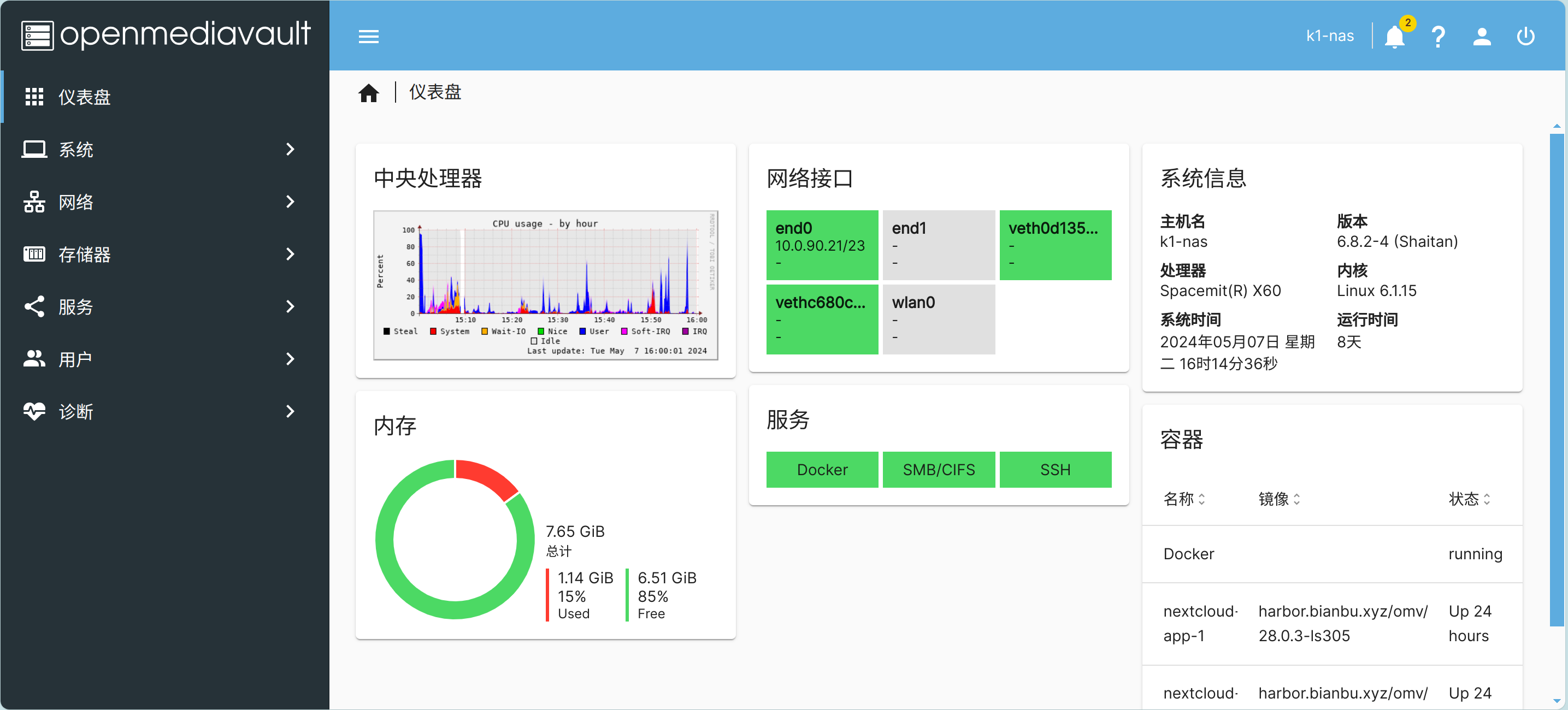
OpenMediaVault (OMV) is an open-source NAS system based on Debian Linux, developed and maintained by Volker Theile. It is designed for home and small-office environments and manages storage and network services through a web interface.
OpenMediaVault ported based on the Bianbu system:
CasaOS
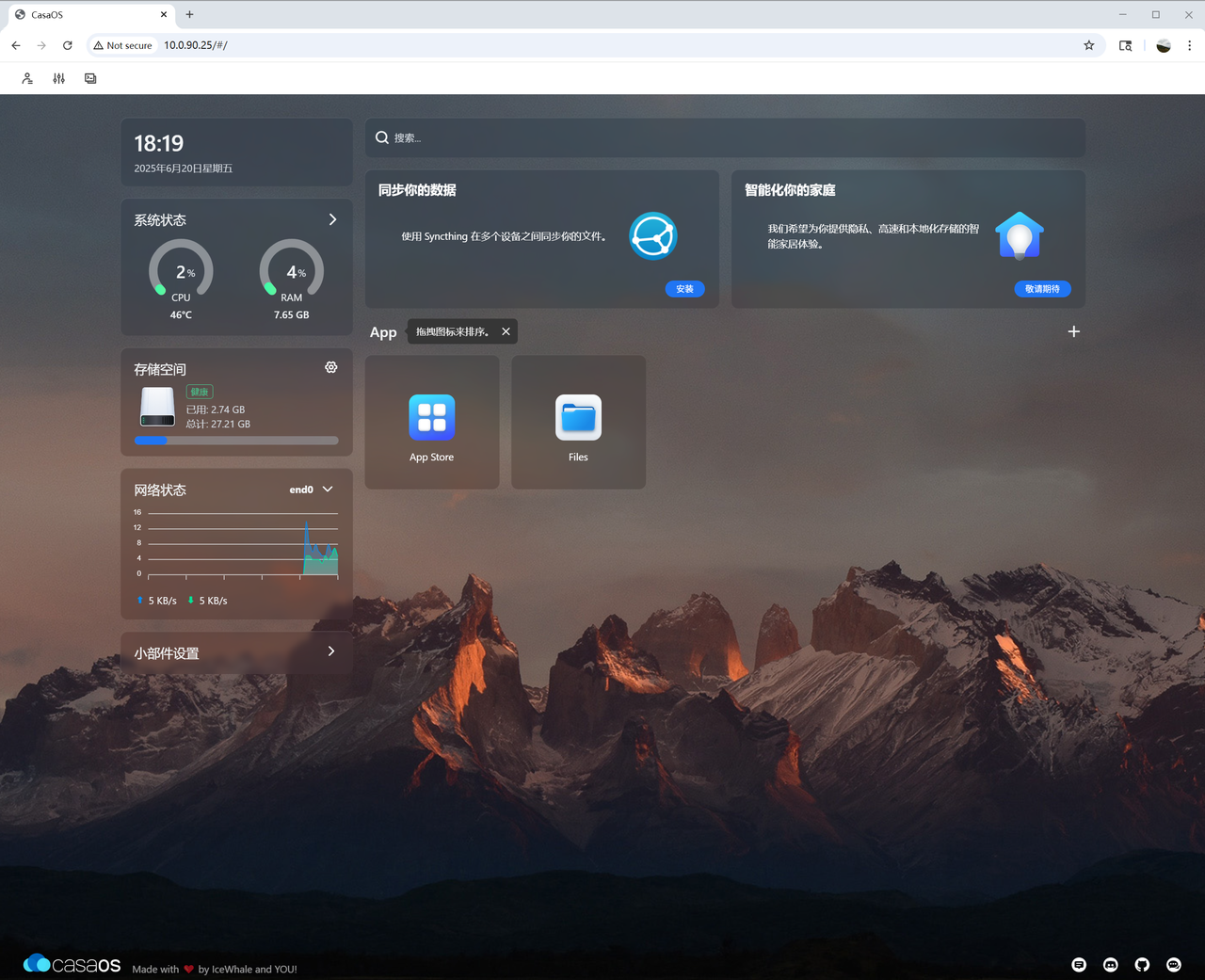
CasaOS is an open-source personal cloud system developed by IceWhale Technology, positioned as a lighter and more user-friendly home cloud platform than OMV.
CasaOS ported based on the Bianbu system:
Technical Support
- Official documentation: https://www.spacemit.com/community/document
- Developer community: https://www.spacemit.com/community
- Issue feedback: submit via the community forum or GitLab Issues