


4.2 Matrix Extension Instruction Set
4.2.1 Instruction Set Overview
The RISC-V Matrix Extension is designed to accelerate one of the most critical operations in AI workloads: matrix multiplication. The canonical form of this operation is:
C+ = A x B
where:
- C is the output matrix,
- A and B are input matrices.
Depending on how input and output operands are mapped to architectural registers, the RISC-V community has proposed three distinct approaches for matrix extensions, as illustrated in the following diagram:
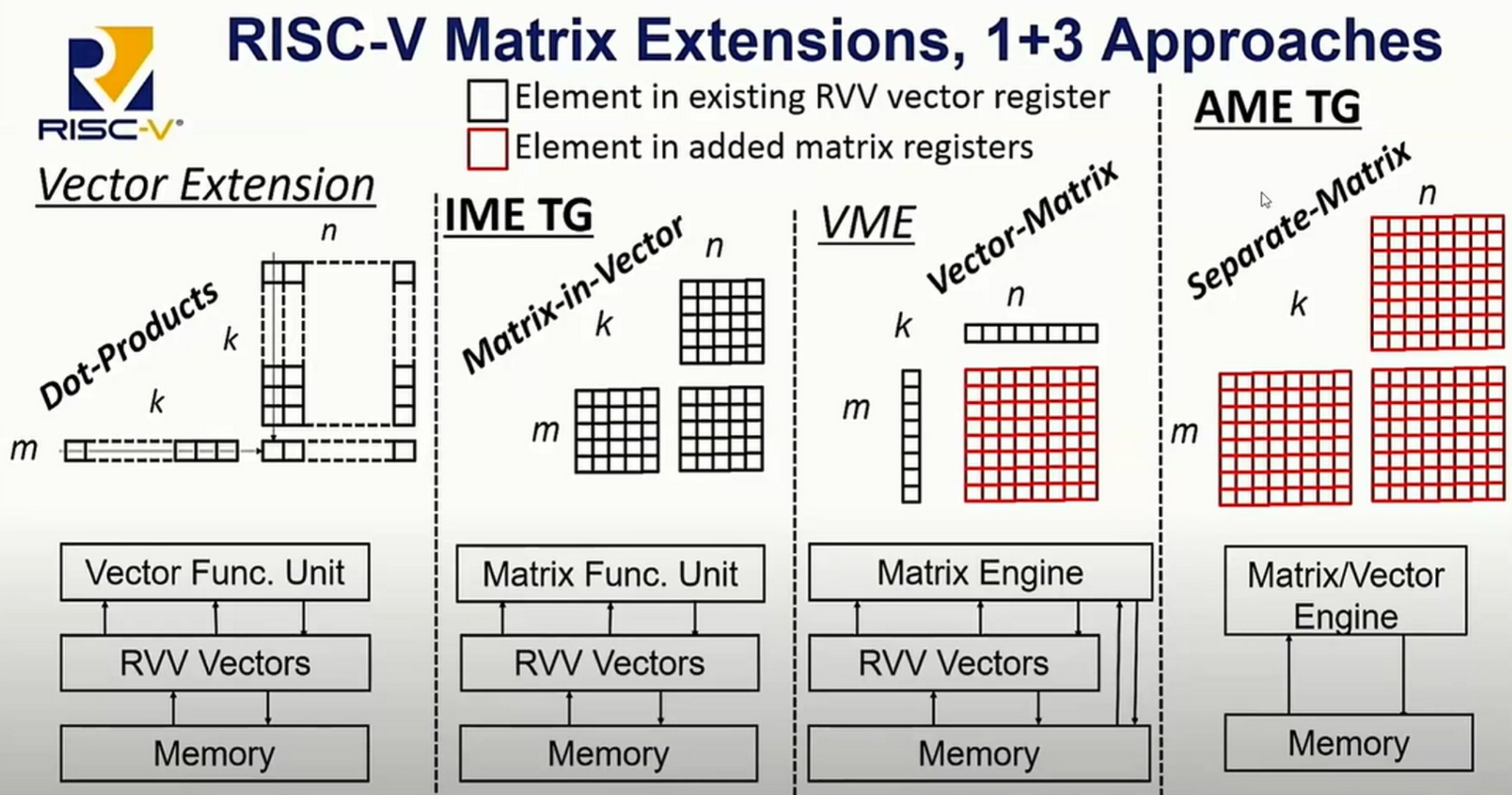
- IME (Integrated Matrix Extension): Both input and output matrices use standard vector registers. For more details, see the IME subgroup.
- VME (Vector-Matrix Extension): Input matrices reuse vector registers, while the output matrix uses dedicated extended registers. For more details, see the VME subgroup.
- AME (Attached Matrix Extension): Both input and output matrices use dedicated registers. For more details, see the AME subgroup.
4.2.2 SpacemiT Instruction Set
SpacemiT's custom matrix extension instruction set is based on the IME proposal. See the full specification here.
In the K1 core (with vlen=256), the matrix compute unit has a native tile shape of:
4 x 8 x 4
Thus, the computational throughput per unit is:
2 x 4 x 8 x 4 x 2Ghz = 0.5TOPS
4.2.3 Basic Usage
SpacemiT's extended instruction set, based on the IME standard, largely follows the programming model of the standard RISC-V vector instruction set.
For reference on standard vector instruction usage, see the relevant documentation.
For examples of IME instruction usage, refer to the sample code repository.