
ROC-RK3399-PC is a phone sized mini PC board。
- Dual-core Cortex-A72 up to 1.8GHz & Quad-core Cortex-A53 up to 1.5GHz
- Mali-T864 GPU,support OpenGL ES1.1/2.0/3.0, OpenCL1.2, DirectX11.1.
- LPDDR4 RAM (4GB)
- 3 x USB 2.0 & 2 x USB 3.0
- 10/100/1000M Ethernet
- IR Receiver Module
- HDMI 2.0a with HDCP 2.2
- DisplayPort 1.2 (4K 60Hz)
- 3 x MIPI interface only for DSI, MIPI1 for DSI or CSI, MIPI2 only for CSI
- eDP 1.3
- I2S, supports 8 channels
- High-Speed eMMC extension interface
- MicroSD (TF) Card Slot
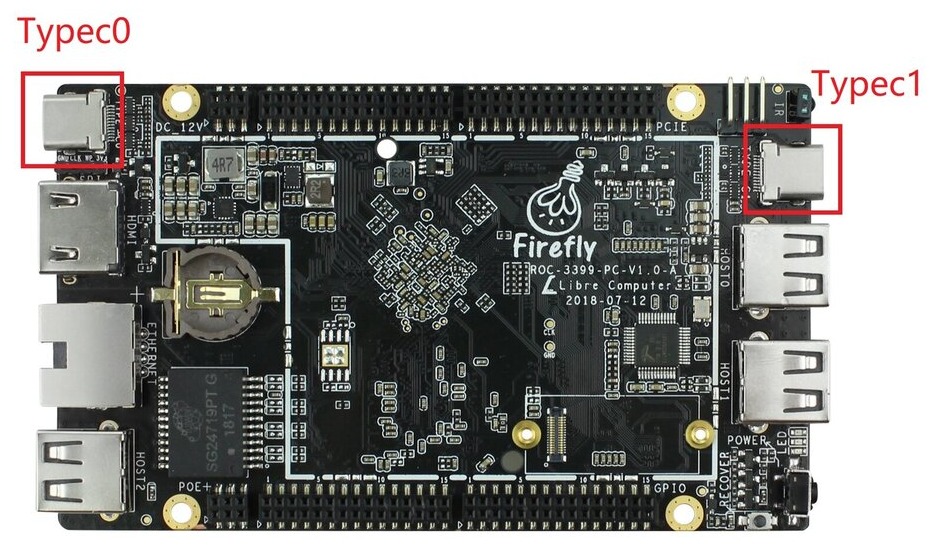
- 2 x Typec interface support DP 1.2、PD 2.0、USB3.0,Typec-1 support DP 1.2、USB3.0
- RTC : battery model -- CR1220 ; Battery seat -- CR1220,BS-12-A3B0J002
- 132 pin expansion interface、SPI、Uart、I2S....
Shipping list (for reference only)
- 1 x ROC-RK3399-PC
- 1 x USB Type-A to Type-C data cable
Accessories
In addition, you may need the following accessories during use:
- PD power supply 15V / 3A (45W)
- SD card, emmc
- ROC-RK3399-PC expansion board
- Serial port module
Note: The development board uses PD (15V / 3A, 45W) power supply, please use it with a suitable power supply.
Development board power on
Before powering up the development board, confirm the following:
- Bootable SD card or eMMC
- 15V / 3A / 45W PD power supply
Since the development board is powered by Type-C0, and Type-C1 supports DP video signal output, there are two cases for booting:
- Connect the independent PD power supply:
- Insert one of the bootable SD cards or eMMC with the power off.
- Plug in an HDMI cable, USB mouse or keyboard (optional).
- After checking that all connections are normal, Type-C0 is connected to the PD power supply and powered on.
- Connect to the Type-C port of the display, and supply power to the board through the display while outputting signals
- Insert one of the bootable SD cards or eMMC with the power off.
- Plug in an HDMI cable, USB mouse or keyboard (optional).
- After checking that all connections are normal, Type-C0 is connected to the Type-C port of the display and powered on.
Note: There are two Type-C ports on the board. ** The power input can only be connected to Type-C0 port **, not to Type-C1.