


Llama.cpp

llama.cpp is a lightweight large-model inference framework designed primarily for local GGUF/GGML model inference. On the SpacemiT RISC-V platform, the CPU inference path can be optimized through hardware capabilities such as RVV and IME, with optional SMT vision extension integration for multimodal workloads. (https://github.com/ggml-org/llama.cpp)
llama.cpp is primarily used to run large language models and multimodal models on edge devices, with the following key capabilities:
- Native support for the GGUF model format, making it well suited for deployment of quantized LLMs.
- Fast validation of model usability and throughput through multi-threaded CPU inference.
- Support for RVV and SpacemiT-specific optimization switches on the SpacemiT RISC-V platform for improved performance.
- Support for multimodal pipelines such as visual encoding when the SMT extension is enabled together with the SpacemiT ONNX Runtime component.
You can download the latest release packages from spacemit-llama.cpp, subscribe to release notifications, or install the package directly from the Bianbu system.
Platform Support
| Platform & OS | Supported |
|---|---|
| K1 Buildroot | ✅ Supported |
| K1 OpenHarmony 5.0 | ❌ Not supported |
| K3 Bianbu LXQT/GNOME | ✅ Supported |
| K3 Buildroot | ✅ Supported |
| K3 OpenHarmony 5.0 | ❌ Not supported |
| K3 Bianbu LXQT/GNOME | ✅ Supported |
Usage Guide (Using Bianbu LXQT/GNOME as an Example)
2.1 Installation
Open a terminal and run the following command to install llama.cpp:
sudo apt update
sudo apt install llama.cpp-tools-spacemitNote: Some legacy platforms or older firmware versions may not provide the llama.cpp-tools-spacemit package. In that case, try:
sudo apt update
sudo apt install llama-server
2.2 Download Models
Acceleration is currently supported for models in five quantization formats. When downloading GGUF models, select one of the following quantization types:
- Q4_K_M
- Q4_0
- Q4_1
- Q2_K
- Q3_K
Select an appropriate model size based on the compute capability of your target chip. For the K1 platform, Qwen3-0.6B is recommended:
wget https://www.modelscope.cn/models/unsloth/Qwen3-0.6B-GGUF/resolve/master/Qwen3-0.6B-Q4_0.gguf -P ~/For the K3 platform, Qwen3-30B-A3B is recommended:
wget https://www.modelscope.cn/models/unsloth/Qwen3-30B-A3B-Instruct-2507-GGUF/resolve/master/Qwen3-30B-A3B-Instruct-2507-Q4_0.gguf -P ~/2.3 Usage
Three common usage methods are available:
- llama-bench (primarily for performance benchmarking)
- llama-cli
- llama-server
The following examples use the K3 platform.
2.3.1 llama-bench (Primarily for Performance Benchmarking)
llama-bench -m Qwen3-30B-A3B-Instruct-2507-Q4_0.gguf -t 8 -p 64 -n 64 -mmp 0 -fa 1Parameters:
-t: Number of threads used for the benchmark (K3: <=8,K1: <=4; for parallel inference, see Section 3)-p: Prompt length, in tokens-n: Output generation length-mmp: Whether to enable multimodal prompt support-fa: Whether to enable Flash Attention
Example output:

2.3.2 llama-cli
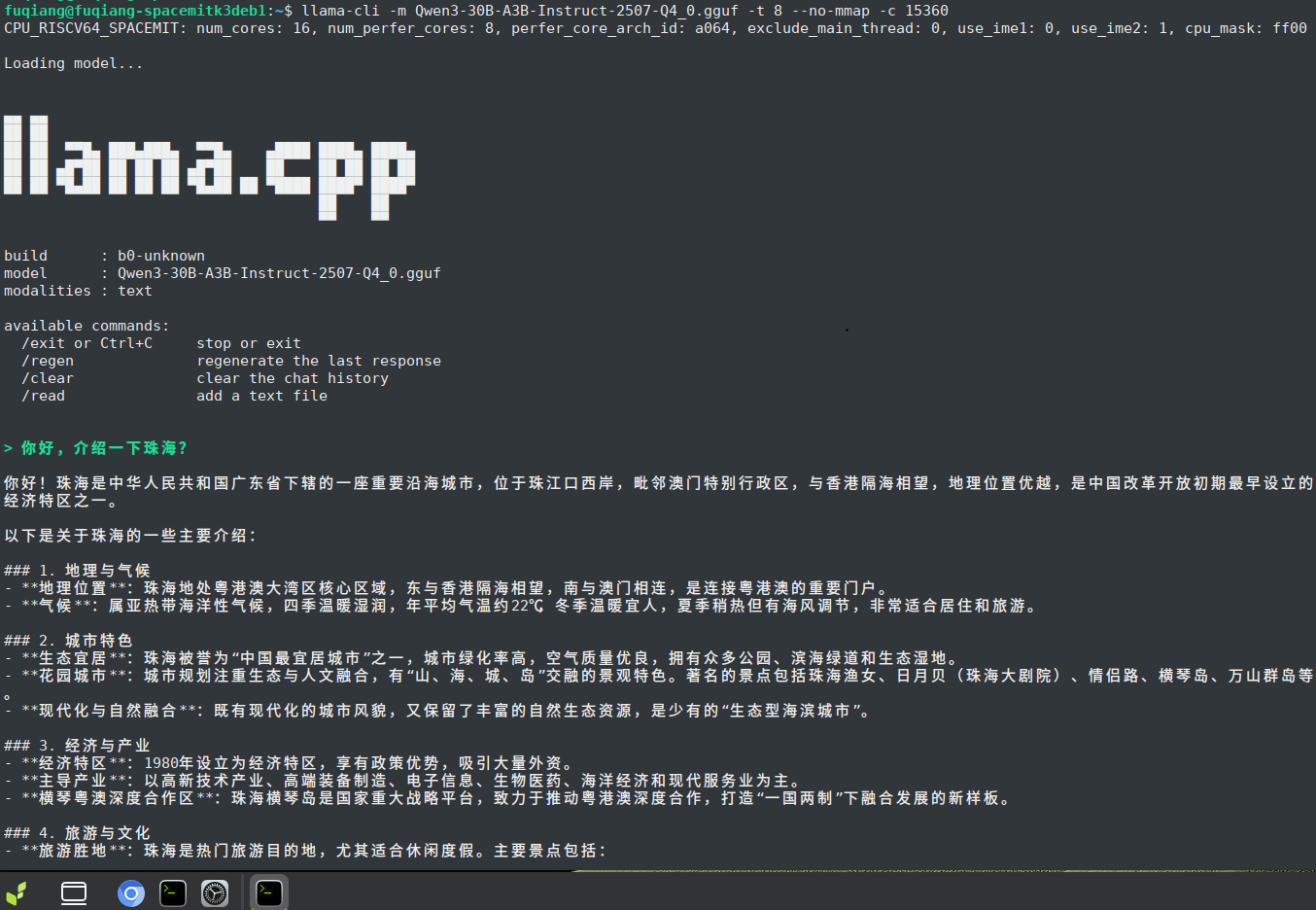
llama-cli -m Qwen3-30B-A3B-Instruct-2507-Q4_0.gguf -t 8 --no-mmap -c 15360Parameters:
-m: Path to the.ggufmodel file-t: Number of threads used for the benchmark (K3: <=8,K1: <=4; for parallel inference, see Section 3)--no-mmap: Disable memory mapping-c: Context size
Example output:
2.3.3 llama-server
Start the llama-server service in the background:
llama-server -m Qwen3-30B-A3B-Instruct-2507-Q4_0.gguf -t 8 --host 127.0.0.1 --port 8080 --ctx-size 15360 --n-gpu-layers 0 --batch-size 512 --metrics --no-mmap &Parameters:
-m: Path to the.ggufmodel file-t: Number of threads used for the benchmark (K3: <=8,K1: <=4; for parallel inference, see Section 3)--host: IP address on which the server listens--port: Server listening port; the default is8080--ctx-size: Model context length in tokens, which affects long-text processing capability--n-gpu-layers: Number of model layers to offload to the GPU to improve inference speed--batch-size: Number of tokens processed per batch, affecting throughput and memory usage--metrics: Enable the Prometheus-format/metricsendpoint for system monitoring and performance analysis--no-mmap: Disable memory mapping-c: Context size
Local API Request
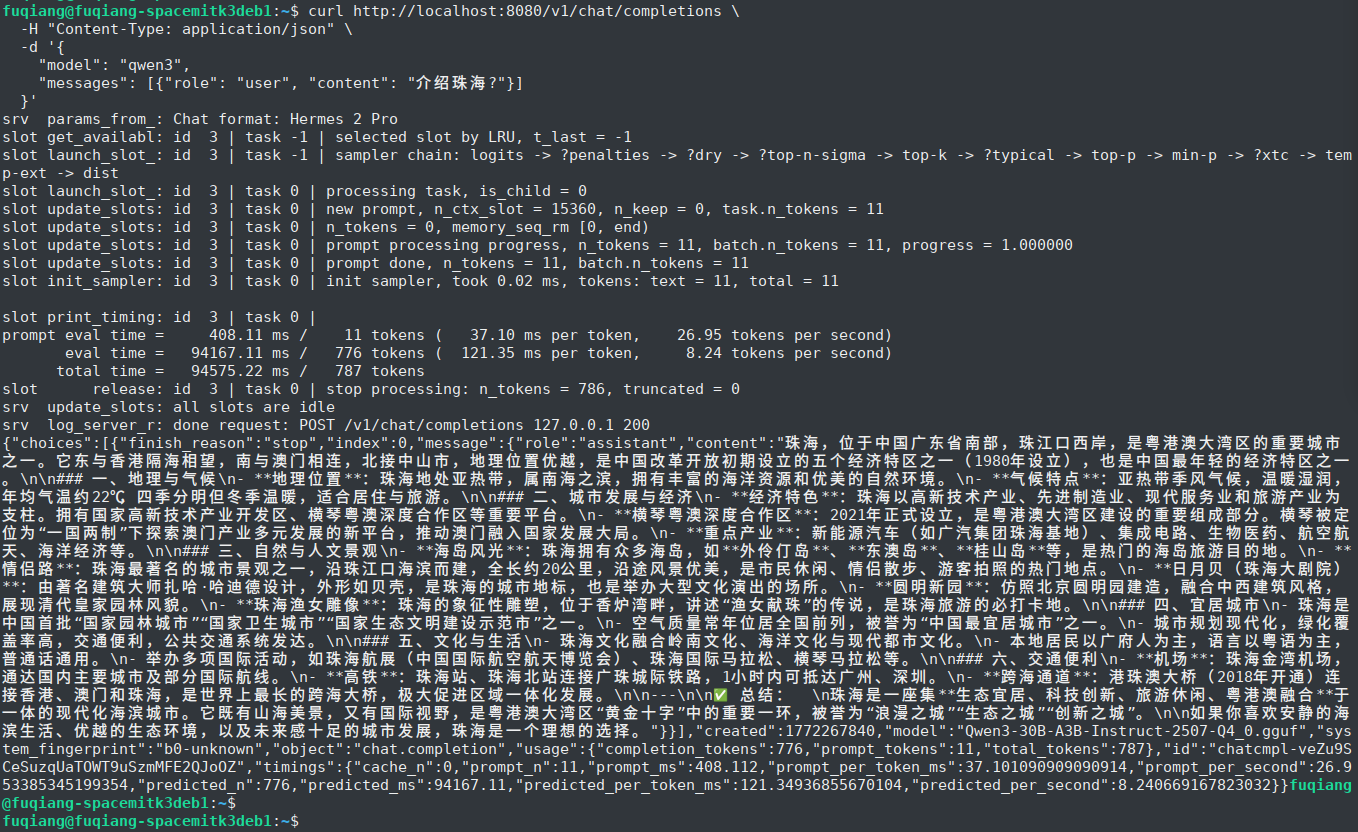
curl -X POST http://127.0.0.1:8080/v1/chat/completions \
  -H "Content-Type: application/json" \
  -d '{
    "model": "Qwen3-30B",
    "messages": [
      { "role": "user", "content": "Introduce Zhuhai." }
    ]
  }'
Example output:
Browser Access
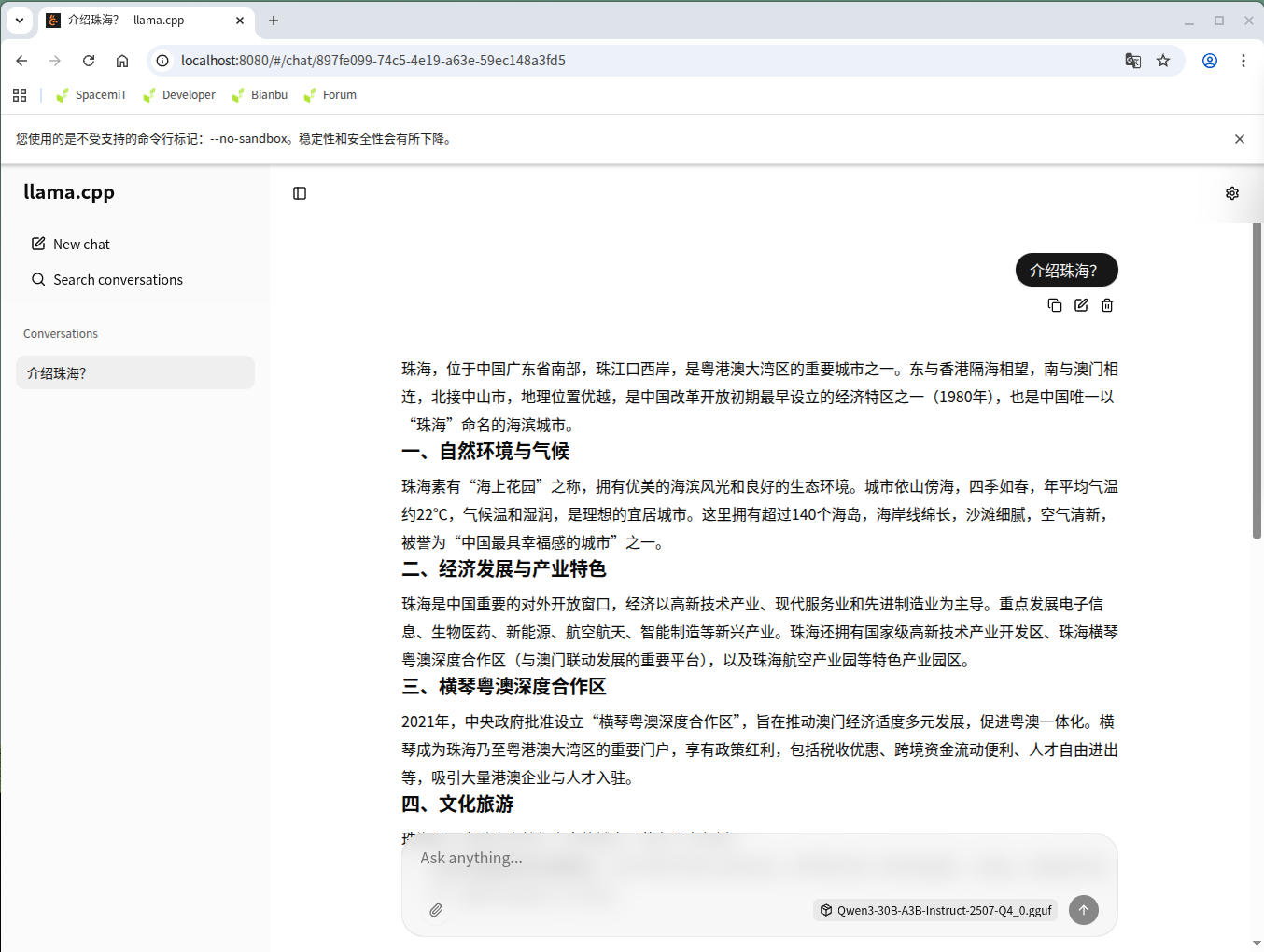
Open http://localhost:8080 in your browser to access the llama server and use llama.cpp directly in the browser.
2.4 Downloading and Running Multimodal Models
Because multimodal model usage differs from standard LLM usage, it is described separately in this section.
2.4.1 Model Download
Multimodal models must be split before they can run in llama.cpp. The split model packages are available at https://archive.spacemit.com/spacemit-ai/model_zoo/vlm/. Popular models currently include:
Qwen3.5-0.8BQwen3.5-2BQwen3.5-4BQwen3-VL-30B-A3Bfastvlm-0.5B
The following sections use several of these models as examples.
2.4.2 Model Preparation
Download the models above and copy them to the K3 device. Prepare several test images in resolutions such as 224x224, 384x384, 512x512, and 768x768. Both .png and .jpg formats are supported.
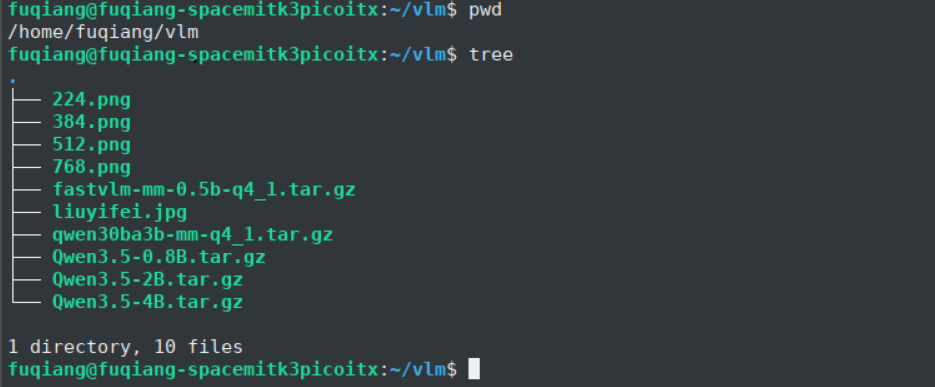
Extract the model files. Using Qwen3.5-0.8B as an example, the extracted contents are as follows:
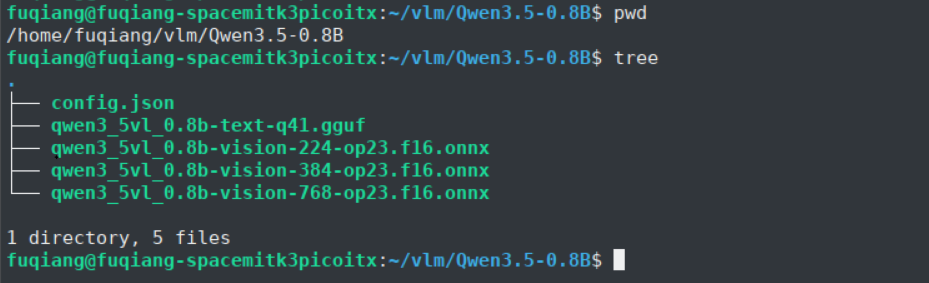
Directory structure:
config.json: Model configuration file, described in detail belowqwen3_5vl_0.8b-text-q41.gguf: The language model portion separated from the VLM modelqwen3_5vl_0.8b-vision-224-op23.fp16.onnx: Vision model portion for224x224inputqwen3_5vl_0.8b-vision-384-op23.fp16.onnx: Vision model portion for384x384inputqwen3_5vl_0.8b-vision-768-op23.fp16.onnx: Vision model portion for768x768input
config.json example:
{
  "architectures": [
    "Qwen3_5ForConditionalGeneration"
  ],
  "vision_model": {
    "model_path": "./qwen3_5vl_0.8b-vision-384-op23.f16.onnx", // Specify the vision model path based on image resolution
    "input_size": 384, // Specify the model input size corresponding to the vision model above
    "spacemit_ep_intra_thread_num": 4, // Number of parallel inference threads
    "spacemit_ep_inter_thread_num": 1 // Number of parallel sessions; usually 1
  },
  "text_model": {
    "model_path": "./qwen3_5vl_0.8b-text-q41.gguf", // Specify the large language model path
    "hidden_size": 1024
  }
}
2.4.3 Model Usage (Non-Qwen3-VL-30B-A3B)
Start the service from the Qwen3.5-0.8B directory with llama-server:
llama-server -m qwen3_5vl_0.8b-text-q41.gguf --media-backend smt --smt-config-dir ./ -t 8 --host 0.0.0.0 --port 8080 --reasoning-budget 0 --reasoning offParameters:
-m: Path to the.ggufmodel file--media-backend: Vision backend; default issmt--smt-config-dir: Vision configuration path-t: Number of threads used for the benchmark (K3: <=8,K1: <=4; for parallel inference, see Section 3)--host: IP address on which the server listens--port: Server listening port; the default is8080--reasoning-budget: Parameter controlling reasoning behavior--reasoning: Enable or disable reasoning
Model loading may take some time, especially for larger models. When the following message appears, the llama-server service has started successfully.

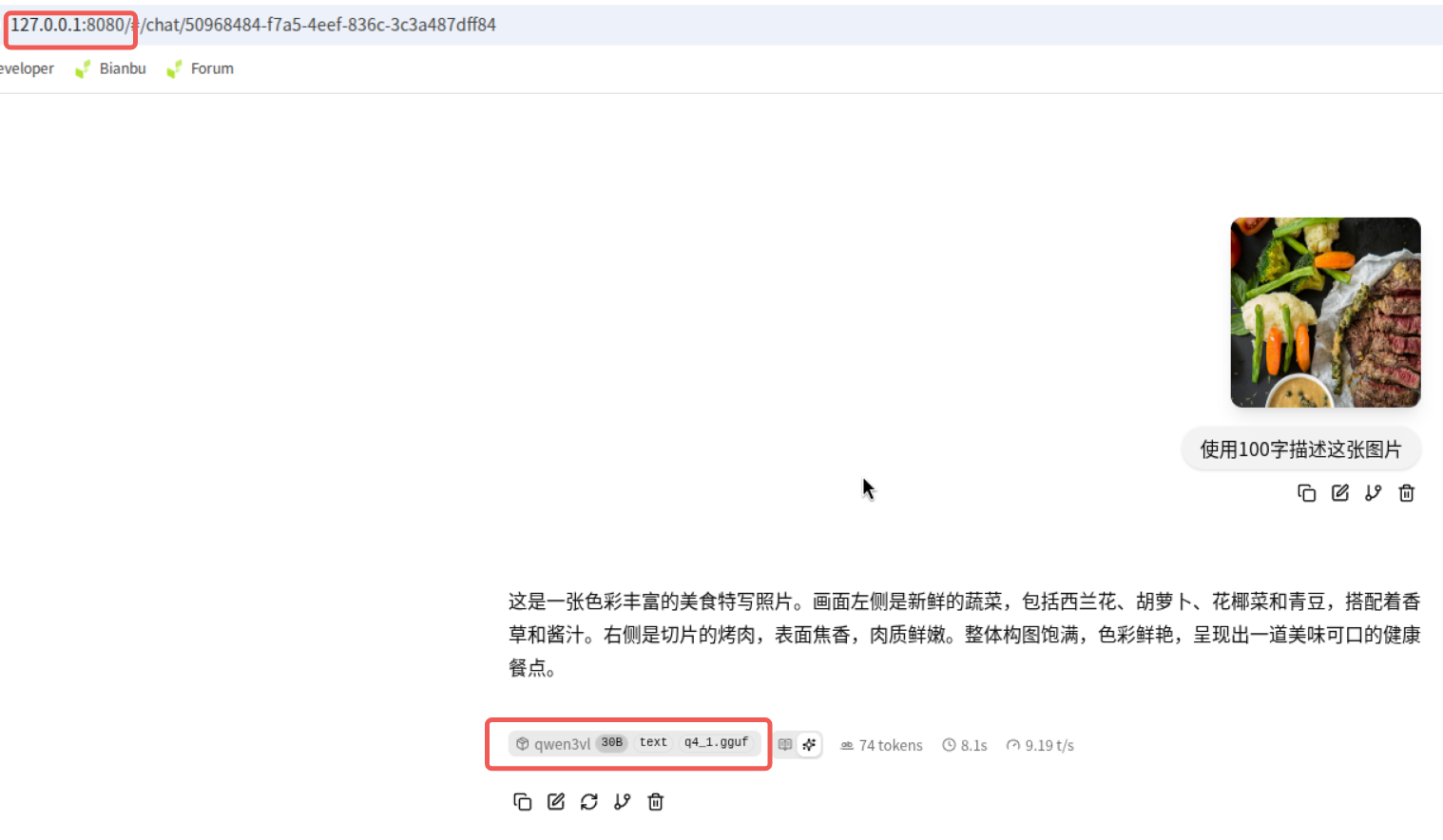
Open 127.0.0.1:8080 in the browser to start the conversation:
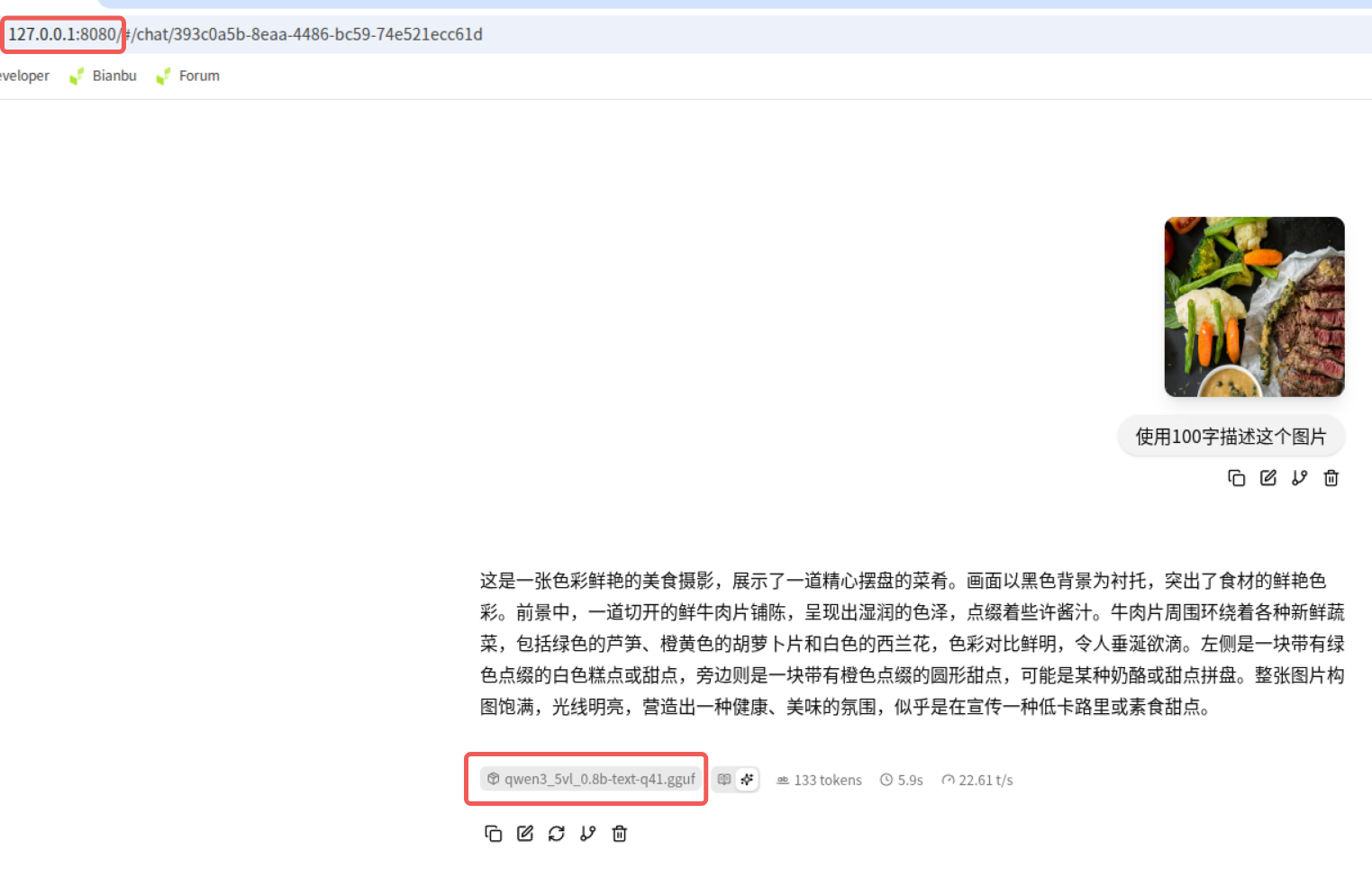
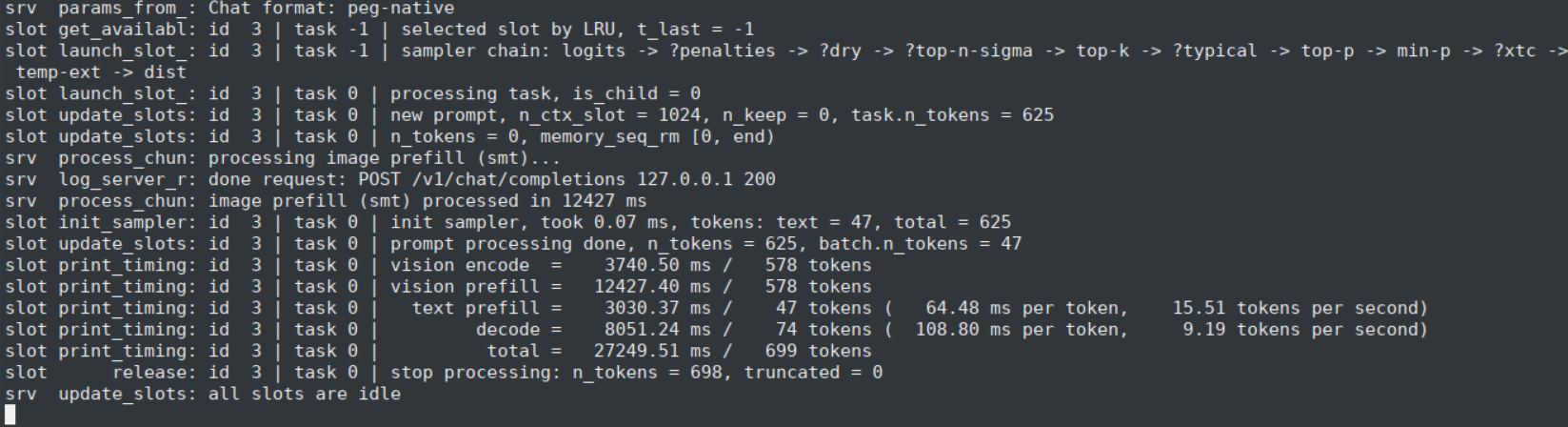
The llama-server terminal prints performance metrics as shown below:
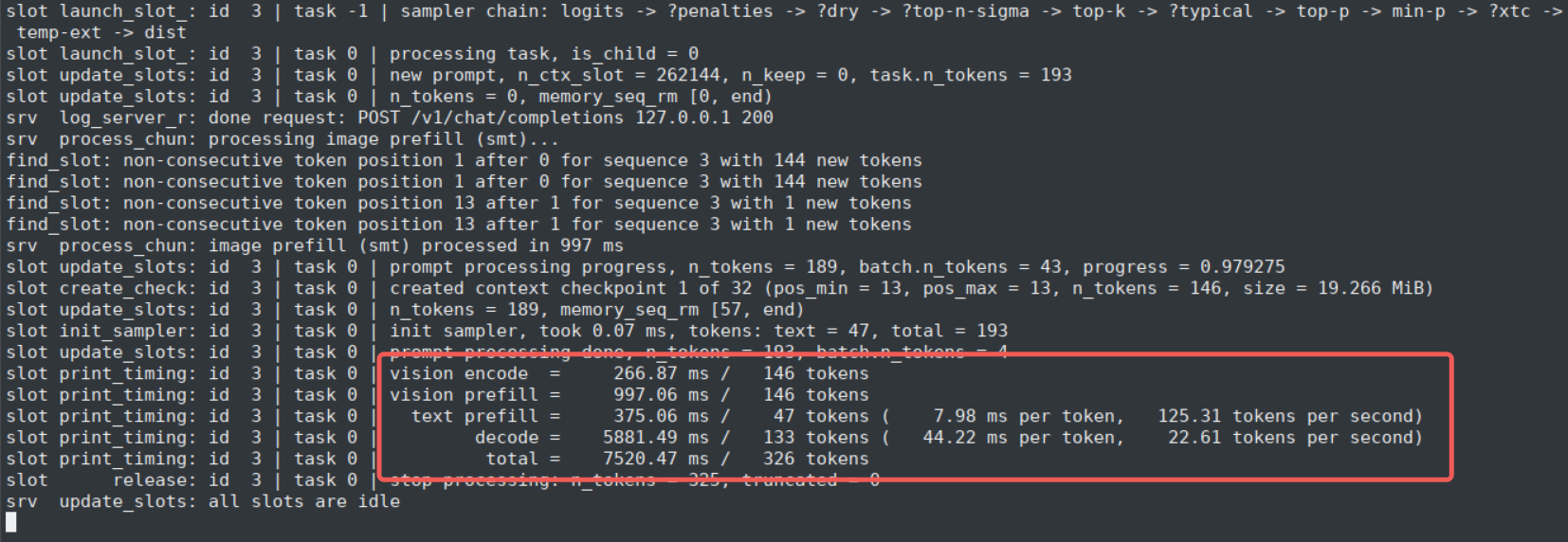
2.4.4 Model Usage (Qwen3-VL-30B-A3B)
Set export SPACEMIT_EP_DENSE_ACCURACY_LEVEL=1 to accelerate ONNX model inference.
Start the service from the qwen30ba3b-mm-q4_1 directory with llama-server:
llama-server -m qwen3vl-30b-text-q4_1.gguf --media-backend smt --smt-config-dir ./ -ctk f16 -ctv f16 -t 8 -tb 8 -c 1024 --host 0.0.0.0 --port 8080 --reasoning-budget 0 --reasoning offParameters:
-m: Path to the.ggufmodel file--media-backend: Vision backend; default issmt--smt-config-dir: Vision configuration path-ctk: Quantization format for the K cache-ctv: Quantization format for the V cache-t: Number of threads used for the benchmark (K3: <=8,K1: <=4; for parallel inference, see Section 3)-tb: Number of CPU threads used for batch processing-c: Context size--host: IP address on which the server listens--port: Server listening port; the default is8080--reasoning-budget: Parameter controlling reasoning behavior--reasoning: Enable or disable reasoning
Open 127.0.0.1:8080 in the browser to start the conversation:
The llama-server terminal prints performance metrics as shown below:
Parallel Inference (Important)
This section uses the K3 platform as an example to explain how to use and manage parallel inference. It also introduces spacemit-tcm-smi, a utility for monitoring inference resources.
3.1 spacemit-tcm-smi
spacemit-tcm-smi is a tool for real-time monitoring and cleanup of inference resources.
3.1.1 Installation
sudo apt update
sudo apt install spacemit-tcm
3.1.2 Usage
spacemit-tcm-smi -h: Display helpspacemit-tcm-smi -i: Monitor TCM status in real timespacemit-tcm-smi -c: Clear TCM state. If a previous inference process exited abnormally, subsequent inference may also fail. In this case, first inspect the TCM state withspacemit-tcm-smi -i, then clear it with this command.
K3 provides 8 AI cores and supports up to 8-thread inference concurrently, provided that thread resources are assigned correctly. The following sections explain several common scenarios.
3.2 Single Inference
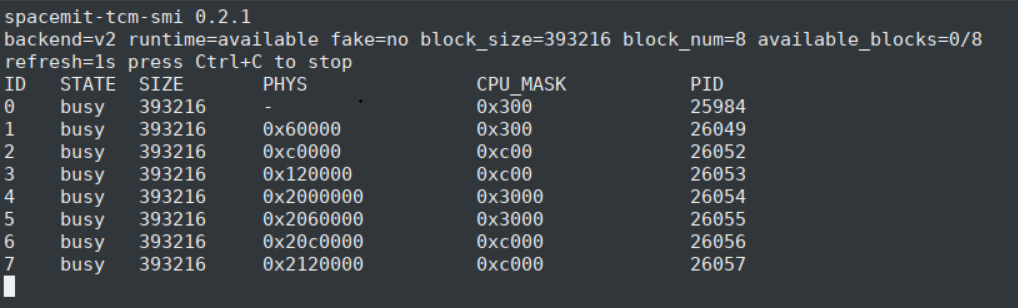
For single inference, simply use -t 8 to occupy all available resources. During inference, run spacemit-tcm-smi -h to inspect resource usage as shown below:
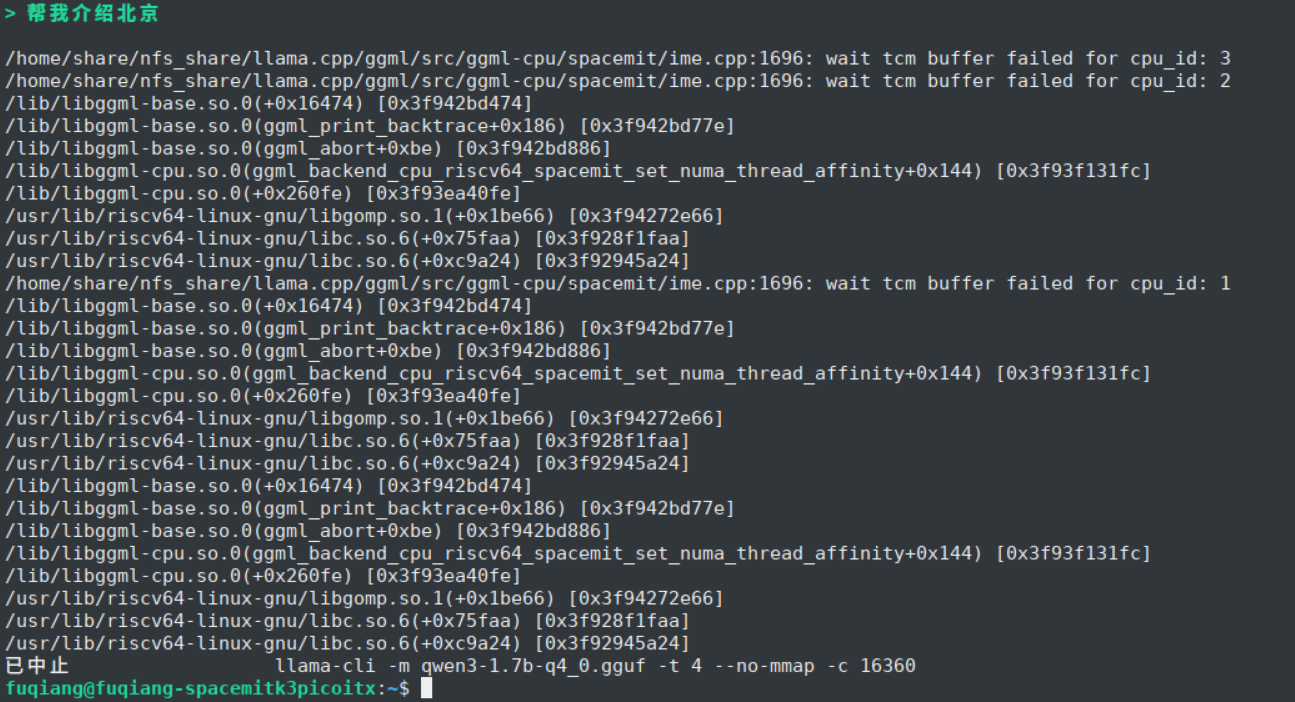
At this point, no additional inference task can be started concurrently. If a second inference task is forced to run, both tasks may fail, as shown below:
Wait until the current inference completes and all TCM states return to free, as shown below, before starting another task.
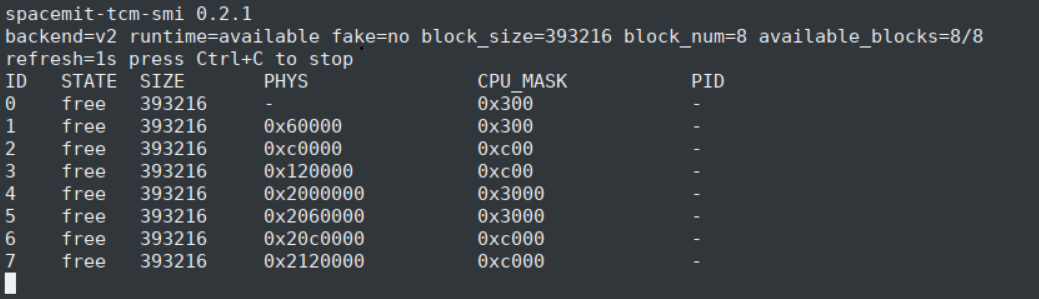
Alternatively, you can forcefully stop the running inference or use spacemit-tcm-smi -c to clear the TCM state and reset it to free before starting a new task.
3.3 Dual Inference
3.3.1 llama + llama
To run two concurrent llama inference tasks, explicitly assign AI cores (8-15) to each task, as shown below.
In one terminal:
export SPACEMIT_PERFER_CORE_ID="8,9,10,11" && llama-cli ...The TCM status then shows four AI cores in use.
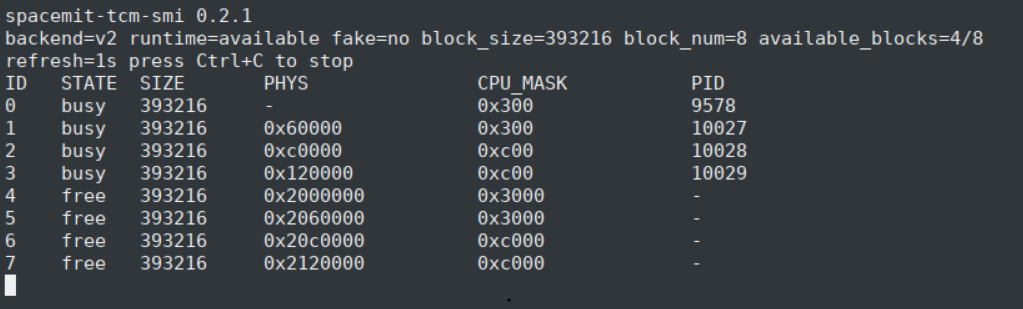
In another terminal:
export SPACEMIT_PERFER_CORE_ID="12,13,14,15" && llama-cli ...At this point, all eight AI cores are active.
This example uses a 4+4 allocation for two inference tasks. Other combinations are also possible depending on workload requirements, such as 2+6 or 1+7.
3.3.2 llama + onnxruntime
Similar to llama + llama, ONNX Runtime also supports core binding. Correct core binding avoids conflicts. Example ONNX Runtime affinity configuration:
std::unordered_map<std::string, std::string> provider_options;
provider_options["SPACEMIT_EP_INTRA_THREAD_NUM"] = "4";
// Bind specific cores
provider_options["SPACEMIT_EP_INTRA_THREAD_AFFINITY"] = "8;9;10;11";
3.3.3 llama + llama Multimodal Extension
In addition to the AI-core binding used in llama + llama, the config.json file must also define ONNX Runtime core affinity, as shown below:
# Method 1: Same approach as above, for example by adding the following to the vision_model field
"vision_model": {
  "model_path": "./xxx.onnx",
  "spacemit_ep_intra_thread_num": 4,
  "spacemit_ep_inter_thread_num": 1,
  "spacemit_ep_intra_thread_affinity": "8;9;10;11"
}

# Method 2 (recommended): Add an ep_config field using the same configuration format as EP
"ep_config": {
  "SPACEMIT_EP_INTRA_THREAD_NUM": "4",
  "SPACEMIT_EP_INTER_THREAD_NUM": "1",
  "SPACEMIT_EP_INTRA_THREAD_AFFINITY": "8;9;10;11"
}
3.4 Multi-Instance Inference
Multi-instance inference follows the same principles as dual inference and must satisfy the following requirements:
- Each inference task must run on different cores.
- The total number of concurrent inference threads must not exceed the number of AI cores (8).
Many combinations are possible, for example: 2+2+4, 2+2+2+2, or 1+1+1+1+1+1+1+1 ...
Native Build on K3
4.1 Install Dependencies
sudo apt install cmake4.2 Download the Source Code
git clone https://github.com/spacemit-com/llama.cpp.git4.3 Build and Install
4.3.1 Base Version
When building on the SpacemiT RISC-V platform, it is recommended to enable GGML_CPU_RISCV64_SPACEMIT to activate platform-specific optimizations.
cd llama.cpp

cmake -B build \
  -DCMAKE_BUILD_TYPE=Release \
  -DGGML_CPU_RISCV64_SPACEMIT=ON \
  -DGGML_CPU_REPACK=OFF \
  -DLLAMA_OPENSSL=OFF \
  -DGGML_RVV=ON \
  -DGGML_RV_ZVFH=ON \
  -DGGML_RV_ZFH=ON \
  -DGGML_RV_ZICBOP=ON \
  -DGGML_RV_ZIHINTPAUSE=ON \
  -DGGML_RV_ZBA=ON \
  -DCMAKE_TOOLCHAIN_FILE=${PWD}/cmake/riscv64-spacemit-linux-gnu-gcc.cmake \
  -DCMAKE_INSTALL_PREFIX=build/installed

cmake --build build --parallel $(nproc) --config Release

cd build
make install
4.3.2 Multimodal Extension Version
If you need to enable the SpacemiT SMT multimodal extension in llama-server or llama-mtmd-cli, the build depends on ONNX Runtime. Prepare an additional SPACEMIT_ORT_DIR directory containing a built ONNX Runtime package. The latest built ONNX Runtime package can be downloaded and extracted from https://archive.spacemit.com/spacemit-ai/onnxruntime/.
Add the following definitions during the build:
export SPACEMIT_ORT_DIR=/path/to/spacemit-ort
export LD_LIBRARY_PATH=${SPACEMIT_ORT_DIR}/lib:${LD_LIBRARY_PATH}

cd llama.cpp

cmake -B build \
  -DCMAKE_BUILD_TYPE=Release \
  -DGGML_CPU_RISCV64_SPACEMIT=ON \
  -DGGML_CPU_REPACK=ON \
  -DLLAMA_OPENSSL=OFF \
  -DGGML_RVV=ON \
  -DGGML_RV_ZVFH=ON \
  -DGGML_RV_ZFH=ON \
  -DGGML_RV_ZICBOP=ON \
  -DGGML_RV_ZIHINTPAUSE=ON \
  -DGGML_RV_ZBA=ON \
  -DCMAKE_TOOLCHAIN_FILE=${PWD}/cmake/riscv64-spacemit-linux-gnu-gcc.cmake \
  -DCMAKE_INSTALL_PREFIX=build/installed \
  -DLLAMA_SERVER_SMT_VISION=ON \
  -DSPACEMIT_ORT_DIR=${SPACEMIT_ORT_DIR}

cmake --build build --parallel $(nproc) --config Release

cd build
make install
Model Performance Data
Obtained using llama-bench